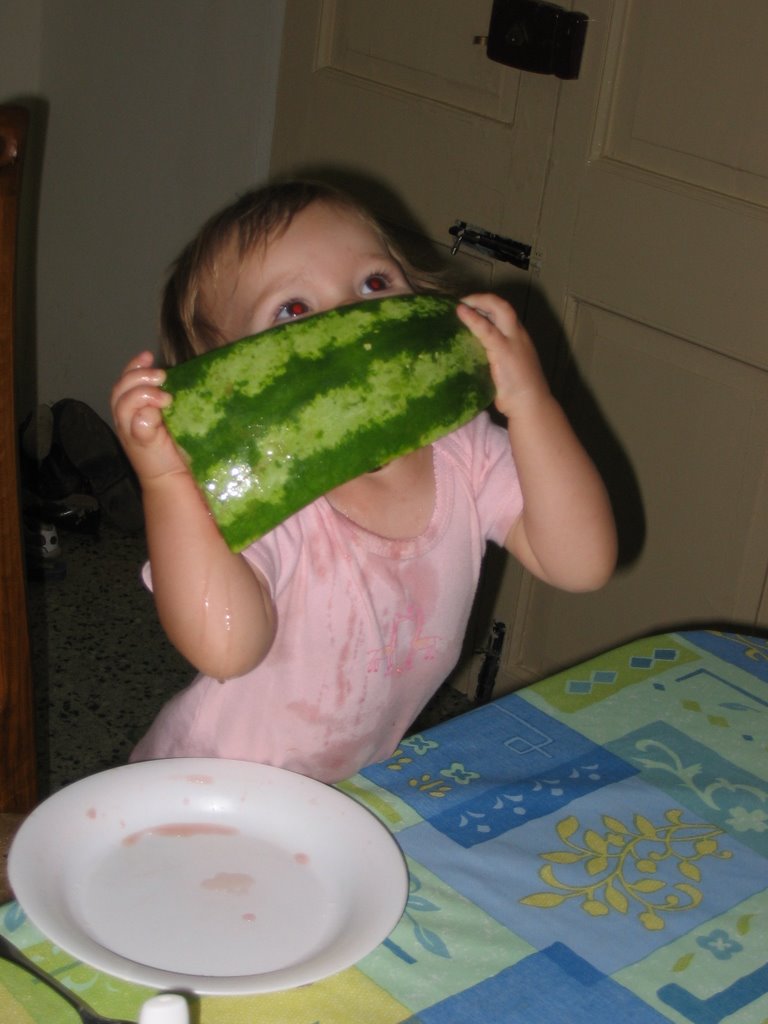
 It's watermelon season! We always buy our produce from roadside stands but now, in addition to the usual stands, there are big piles of watermelon for sale along the sides of major roads. Eleanor has decided watermelon is her favorite food, and Isaac has composed a song to sing while eating watermelon (to the tune of "Shoo Fly"), "Black seeds, don't bother me, black seeds don't bother me..."
Thursday, August 31, 2006
Must be summer
It's watermelon season! We always buy our produce from roadside stands but now, in addition to the usual stands, there are big piles of watermelon for sale along the sides of major roads. Eleanor has decided watermelon is her favorite food, and Isaac has composed a song to sing while eating watermelon (to the tune of "Shoo Fly"), "Black seeds, don't bother me, black seeds don't bother me..."

To market, to market
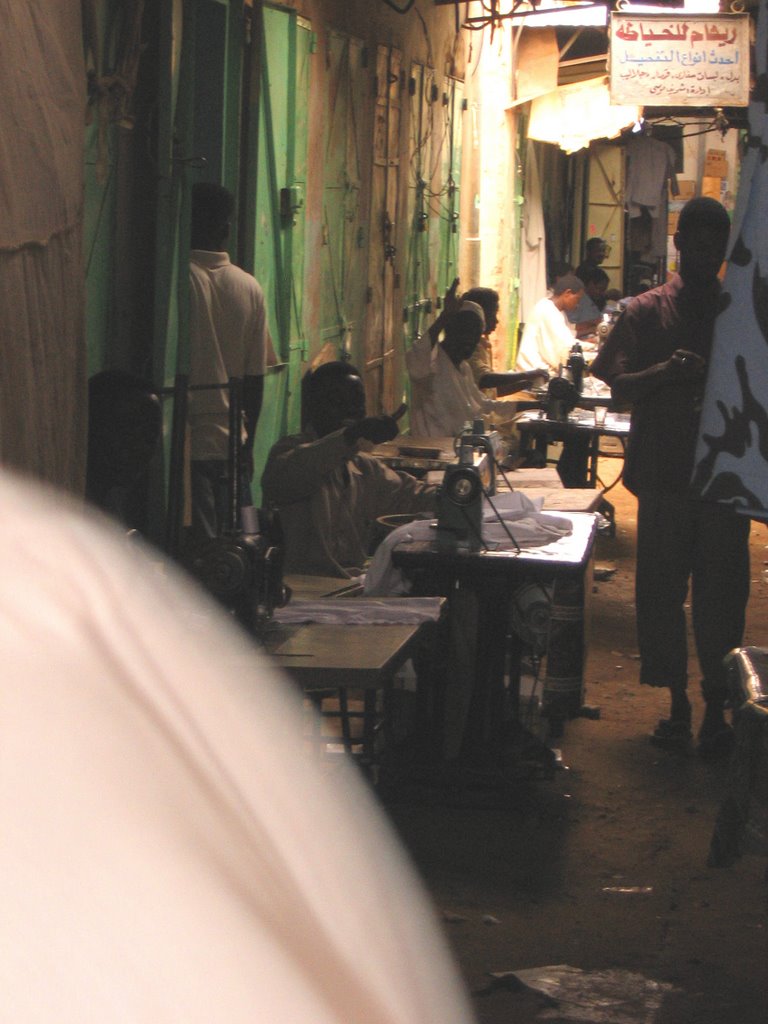
Friends showed us Khartoum's souq (market) last weekend. It covers many blocks. Stands with all sorts of merchandise line covered walkways (welcome relief from the heat). Every aisle has its own specialty--the plastics souq, the cheap Chinese toys souq, the shoes and the clothes and the carpentry and the fabric souqs. In between the fabric stands there were aisle after aisle of treadle sewing machine, each manned (literally--I didn't see any women) by someone waiting to whip up a set of curtains or drapes while you waited. I've never before seen so many treadle sewing machines in one place. My favorite aisle was the flip-flop aisle; there were about ten cobbler benches lined up, each with a cobbler industriously making plastic flip-flops for sale!
Wednesday, August 30, 2006
Who's in charge?

Eleanor first started making her "you're-not-the-boss-of-me" face at Ruth, but she now makes it regularly at all of us, whenever we suggest something that doesn't meet with her approval.
Ice castles
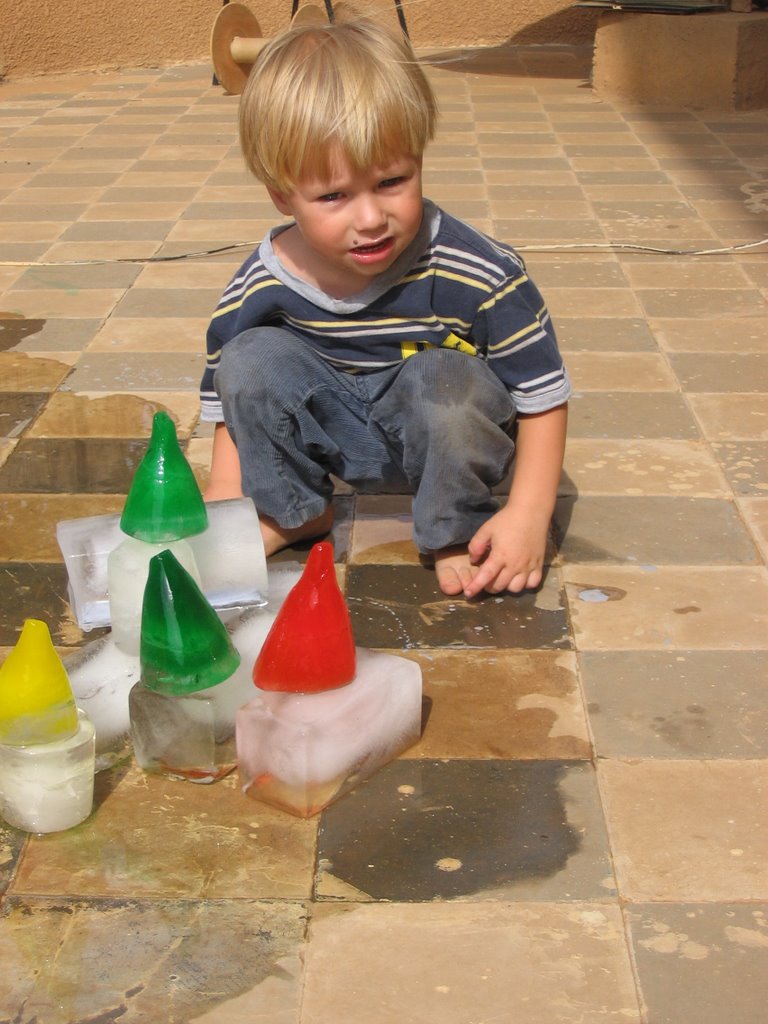
We made giant ice cubes (some with colored water) in milk cartons and water bottles and then built castles on the front balcony. Cool fun for a hot day.
Tuesday, August 29, 2006
Life at KAS
KAS - Kids Are Smart. The 'creative' title of the map I made of the campus of our school, as requested by the Social Studies teacher. Every day at KAS is different then the one before. Schedules are changed, classes are switched, and teachers are late, early, or forget they have a class at all. To counter this inconsistency, there are some things which are always the same. For example, the P.E. teacher is always late for class. He is funny, nice, (though he always pretends he's the meanest P.E. teacher alive) and very Australian.
The Social Studies teacher is nice enough, if a bit harsh when it comes to homework. Social Studies is one of the classes where you feel obligated to get everything right. The Social Studies teacher is friendly despite this, interacts well with his students, and has a tattoo. (The major point of middle school gossip.)
My Science teacher also teaches homeroom. He is a very good teacher, though in homeroom, which we call advisory, it can be said that nobody is particularly interested in telling him their problems.
The math teacher's been very good at recognizing individual students' needs, and helping them with them. He also takes us for what we call 'exploratory'. Normally each teacher would pick something they want to teach as an extra class and the students would choose which class they wanted to go in, but since the French teacher decided her class was too big for her to teach effectively, the 7th grade schedule was fiddled around with, so now we play basketball or chess with the math teacher during exploratory hours.
Madame, the French teacher is strict and expects perfection, but is actually a very good French teacher. I do not particularly enjoy French, but I learn a lot in it.
The art teacher is very effective. In his class I never feel like I have to get everything right. He is very flexible and very supportive
My favorite class of all is Language Arts. We have the superintendent's son for that. His class consists of reading assigned books, writing assigned pieces, and also reading and writing free choice. I have never been able to immerse myself in literature as well as I have with the LA teacher.
And then there's the students. One class a grade, fifteen students a class on average. I have been impressed by how much the boys and girl interact with each other. Girls are more willing to lend their erasers to boys, and boys are more willing to sit by a girl then in any other school I have been in. KAS is a good and interesting school, and probably has one of the best staffs and most fun set of students I have ever seen.
The Social Studies teacher is nice enough, if a bit harsh when it comes to homework. Social Studies is one of the classes where you feel obligated to get everything right. The Social Studies teacher is friendly despite this, interacts well with his students, and has a tattoo. (The major point of middle school gossip.)
My Science teacher also teaches homeroom. He is a very good teacher, though in homeroom, which we call advisory, it can be said that nobody is particularly interested in telling him their problems.
The math teacher's been very good at recognizing individual students' needs, and helping them with them. He also takes us for what we call 'exploratory'. Normally each teacher would pick something they want to teach as an extra class and the students would choose which class they wanted to go in, but since the French teacher decided her class was too big for her to teach effectively, the 7th grade schedule was fiddled around with, so now we play basketball or chess with the math teacher during exploratory hours.
Madame, the French teacher is strict and expects perfection, but is actually a very good French teacher. I do not particularly enjoy French, but I learn a lot in it.
The art teacher is very effective. In his class I never feel like I have to get everything right. He is very flexible and very supportive
My favorite class of all is Language Arts. We have the superintendent's son for that. His class consists of reading assigned books, writing assigned pieces, and also reading and writing free choice. I have never been able to immerse myself in literature as well as I have with the LA teacher.
And then there's the students. One class a grade, fifteen students a class on average. I have been impressed by how much the boys and girl interact with each other. Girls are more willing to lend their erasers to boys, and boys are more willing to sit by a girl then in any other school I have been in. KAS is a good and interesting school, and probably has one of the best staffs and most fun set of students I have ever seen.
Missing photos
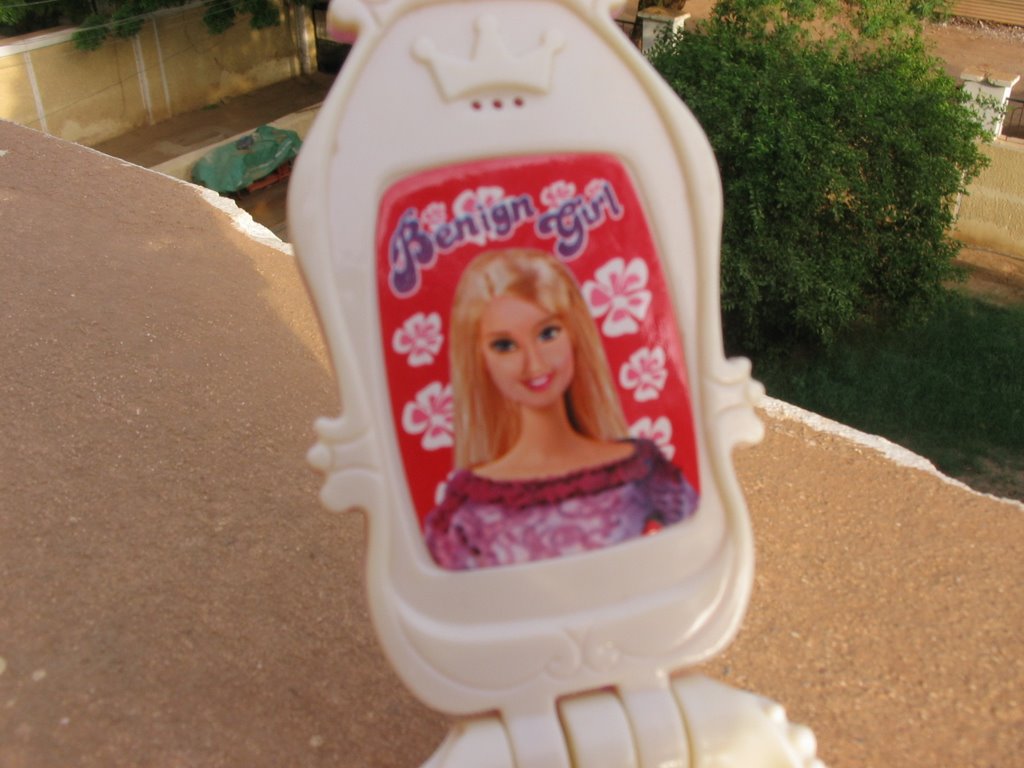
We're having trouble downloading photos--perhaps our slow dial-up internet speed? So we get frustrated and post photo-less posts. Here is a photo to go with Ruth's "Gifts from a Hardware Store" post. If it downloads, that is...
Thursday, August 24, 2006
Gifts from a Hardware Store
Since none of us want to get malaria, Mom and Dad insist that we all have mosquito nets over our beds. UNICEF distributes insecticide-treated netting that's ready to hang, and you can buy it pretty cheap at the souq from locals looking to make a little money. So Dad got nets for everyone, but for a while we had no place to hang them. Our apartment has relatively high ceilings, and our bed frames are modest; no four-posters for us. We took a hint from the man who sleeps on the downstairs porch: he has some sticks tied to each corner of his bed and drapes the mosquito net over them. Unfortunately, we have no reliable source for long, straight sticks.
Instead, Dad and I hopped in the car -- one of the ubiquitous white SUVs in this town (most have "UN" emblazoned on the side) -- and drove around town looking for PVC pipe. We found the auto repair neighborhood, and the furniture neighborhood, and a residential mud hut neighborhood, but couldn't seem to turn up a hardware store until we were on our way home. I guess we just missed it the first time, straight across from the huge city graveyard (maybe we'll post a picture sometime . . . the graver markers are just sticks with bits of paper or plywood stuck to them, and someone pointed it out to us once and said, "Finished. All the finished people there.").
It was a weird kind of hardware store. I found some PVC pipe, which was perfect, and we also got some rope to tie it to bed-frames with. But there were also lots and lots of ornamental daggers. And dishtowels. And life jackets. The man behind the counter looked at our purchases, took our money, and solemnly handed us some wrapped toffees that were sticky to the touch. Dad asked him some advice about where we could get our house key copied. His answer was unintelligible, but the guy warmed up considerably in giving it. Before we left, he smiled in an avuncular manner, gestured at me, and said to Dad, "My friend, this your wife?"
As Dad speculated, perhaps it was not a case of someone thinking I was older than I am. It could have been that the guy thought Dad had a 16-year old wife. Shiver.
Indeed, there is an NGO in our neighborhood called "Charitable Fund Helping Youth Marriage." I'm not sure I want to know what that's all about.
Another week, we returned to the same hardware store, looking for cheap plastic drawers. This time, Mom came along with baby Eleanor in tow. The owner man remembered us, and his two assistants (probably his wife and daughter) spent a long time in whispered discussion as we introduced Dad's actual wife and Eleanor generally acted cute. Then when we left, one of the women stopped us and gave us gifts that they'd pulled off their shelves: for me, a Minnie Mouse photo album, and for Eleanor, a pink plastic mobile phone.
Eleanor adores it. She's always been a phone-talking kid. But what I like about it is the packaging. It's designed to look like a Barbie product, and it's clear that somebody wrote the copy using a translation dictionary; the box says Phone of elegance with soft keys. The best thing is the brand name, though: Benign Girl.
As Dad said, if it's not a perfect name, it's certainly a heck of a lot better than Malignant Girl.
Instead, Dad and I hopped in the car -- one of the ubiquitous white SUVs in this town (most have "UN" emblazoned on the side) -- and drove around town looking for PVC pipe. We found the auto repair neighborhood, and the furniture neighborhood, and a residential mud hut neighborhood, but couldn't seem to turn up a hardware store until we were on our way home. I guess we just missed it the first time, straight across from the huge city graveyard (maybe we'll post a picture sometime . . . the graver markers are just sticks with bits of paper or plywood stuck to them, and someone pointed it out to us once and said, "Finished. All the finished people there.").
It was a weird kind of hardware store. I found some PVC pipe, which was perfect, and we also got some rope to tie it to bed-frames with. But there were also lots and lots of ornamental daggers. And dishtowels. And life jackets. The man behind the counter looked at our purchases, took our money, and solemnly handed us some wrapped toffees that were sticky to the touch. Dad asked him some advice about where we could get our house key copied. His answer was unintelligible, but the guy warmed up considerably in giving it. Before we left, he smiled in an avuncular manner, gestured at me, and said to Dad, "My friend, this your wife?"
As Dad speculated, perhaps it was not a case of someone thinking I was older than I am. It could have been that the guy thought Dad had a 16-year old wife. Shiver.
Indeed, there is an NGO in our neighborhood called "Charitable Fund Helping Youth Marriage." I'm not sure I want to know what that's all about.
Another week, we returned to the same hardware store, looking for cheap plastic drawers. This time, Mom came along with baby Eleanor in tow. The owner man remembered us, and his two assistants (probably his wife and daughter) spent a long time in whispered discussion as we introduced Dad's actual wife and Eleanor generally acted cute. Then when we left, one of the women stopped us and gave us gifts that they'd pulled off their shelves: for me, a Minnie Mouse photo album, and for Eleanor, a pink plastic mobile phone.
Eleanor adores it. She's always been a phone-talking kid. But what I like about it is the packaging. It's designed to look like a Barbie product, and it's clear that somebody wrote the copy using a translation dictionary; the box says Phone of elegance with soft keys. The best thing is the brand name, though: Benign Girl.
As Dad said, if it's not a perfect name, it's certainly a heck of a lot better than Malignant Girl.
Wednesday, August 23, 2006
Homemade birthday presents
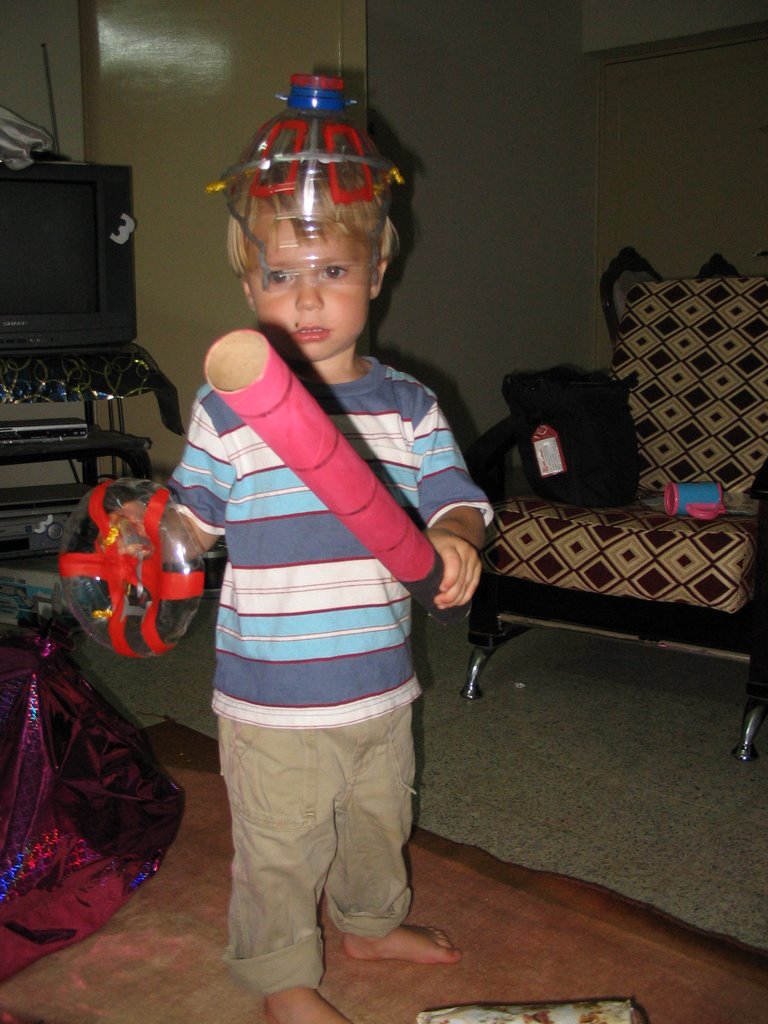
Ruth and Lucy and Ed have inspired me! It's hard to buy stuff here, so the big kids made Isaac birthday presents. And what presents!
Ed cut up empty water jugs and used the extra rope from putting up mosquito netting and made Isaac a knight costume. Isaac looks very fierce when he uses the costume!
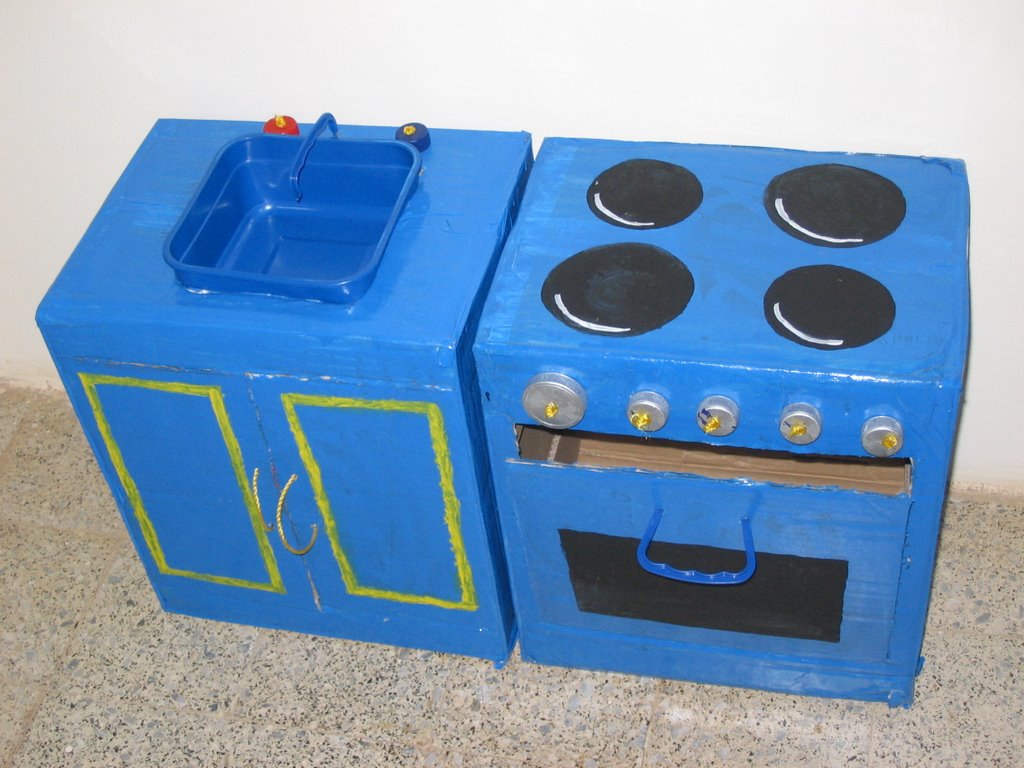
Ruth and Lucy used two cardboard boxes (something we do have plenty of!), paint, an ice cream container, and lids and handles from empty water jugs to create this wonderful kitchen set.
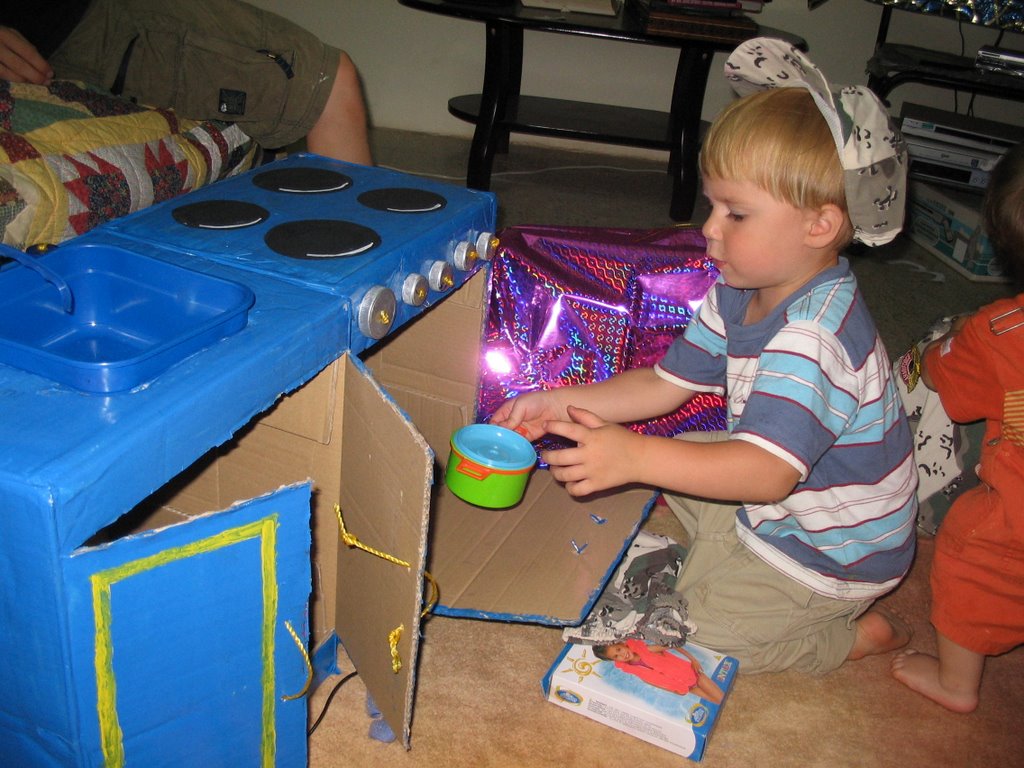
Isaac had to stop opening presents long enough to bake a birthday cake in his new kitchen set.
New clothes

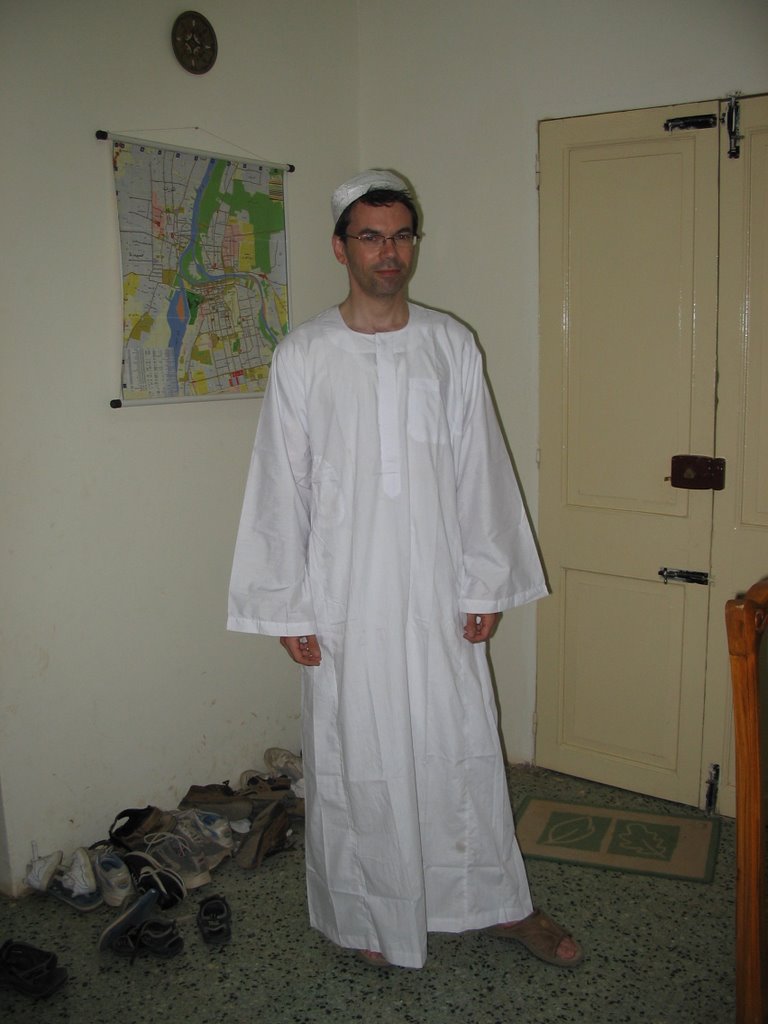
People have guessed that the kids and I are Dutch, French, and British (never American—maybe because there are so few Americans here?). But not when David’s around. They guess that he is Egyptian or Turkish. With his new outfit, nobody is going to believe he’s American.
This is the standard Sudanese outfit—on any given day, about a third of the men in the streets are wearing this, more on the weekends.
Tuesday, August 22, 2006
Hired help
We have an Ethiopian housekeeper, Saga, who comes in two mornings a week. She sweeps and mops the house one morning and washes and irons the laundry the other morning. We pay her the rate she asked for when we hired her--about ten dollars each morning, which comes to a little less than 3 dollars an hour. I have worried about whether we should have offered her more or whether we should simply pay her more. Until I had a conversation with another mom at play group. She was aghast at how much we pay. She has a housekeeper forty hours a week, and she pays her about 6 dollars a day, which works out to about 75 cents an hour! And her Sudanese neighbors pay their housekeeper less than 70 cents an hour.
After my initial indignation that we’re overpaying, David and I decided that, while next time we hire help we might try to negotiate a little harder, we are definitely happy that we are not paying at the bottom of the pay scale. David compared it to the feeling when we go to the souq and someone quotes us what we think is an outrageous price (doubtless because we’re kawaji—white foreigners) and we bargain and negotiate and get a much lower price and walk away realizing that we were just arguing over 50 cents. And 50 cents that the vendor probably needed a lot more than we do!
On the other hand, I have never been shopping or riding a taxi with an African where they have not negotiated the price—and negotiated much harder than I ever would have. It appears to simply be the way business is conducted.
So, we’ll keep on negotiating as much as we can stand to and we’ll continue to almost always end up paying more than we probably need to and we’ll try to remember that we probably have more than almost anyone we’re negotiating with.
After my initial indignation that we’re overpaying, David and I decided that, while next time we hire help we might try to negotiate a little harder, we are definitely happy that we are not paying at the bottom of the pay scale. David compared it to the feeling when we go to the souq and someone quotes us what we think is an outrageous price (doubtless because we’re kawaji—white foreigners) and we bargain and negotiate and get a much lower price and walk away realizing that we were just arguing over 50 cents. And 50 cents that the vendor probably needed a lot more than we do!
On the other hand, I have never been shopping or riding a taxi with an African where they have not negotiated the price—and negotiated much harder than I ever would have. It appears to simply be the way business is conducted.
So, we’ll keep on negotiating as much as we can stand to and we’ll continue to almost always end up paying more than we probably need to and we’ll try to remember that we probably have more than almost anyone we’re negotiating with.
Monday, August 21, 2006
Deadbeats by Accident
The phone hasn’t worked for almost a week (which means we’ve had no internet service either). I thought at first it was city-wide, but when our phone stayed out day after day after day, David finally figured it must be something else. We talked to our realtor, and she investigated for us. Turns out we had a phone bill we hadn’t paid, so they cut off our phone service. Same thing happened for the water service to our house last month. Just as we did with the water bill, we gave our realtor the money and she has paid our phone bill for us.
So I still don’t know how we are supposed to a) know we have a bill; and b) pay it. There is no house-to-house mail service in Sudan, so nobody sends bills. I guess you just know that you have to pay it every month? And in Sudan there are no checks, no credit cards, no ATM cards, no account-to-account transfers. You face someone across a counter and pay them cold, hard cash. So I still need to figure out where to go to pay phone and water bills.
Electricity I have figured out. You pre-pay (with cash) at the Electricity Building. They give me a code that I type into the meter, and it keeps track of how much I have used. We go once a week to buy electricity. Isaac loves to go with me because their lobby is very well-air-conditioned and has comfy seats. He sits down with all the old men who are resting there and waits while I buy power.
The way the water bill is assessed strikes me as odd—especially for a desert country. Every building pays a flat rate for connection to the water system. That means that our building, which now has only two tenants since the lady downstairs passed away, still pays the same rate even though our consumption has been cut dramatically. If the people upstairs were to move away, our water costs would double although the consumption of water would fall even farther.
So I still don’t know how we are supposed to a) know we have a bill; and b) pay it. There is no house-to-house mail service in Sudan, so nobody sends bills. I guess you just know that you have to pay it every month? And in Sudan there are no checks, no credit cards, no ATM cards, no account-to-account transfers. You face someone across a counter and pay them cold, hard cash. So I still need to figure out where to go to pay phone and water bills.
Electricity I have figured out. You pre-pay (with cash) at the Electricity Building. They give me a code that I type into the meter, and it keeps track of how much I have used. We go once a week to buy electricity. Isaac loves to go with me because their lobby is very well-air-conditioned and has comfy seats. He sits down with all the old men who are resting there and waits while I buy power.
The way the water bill is assessed strikes me as odd—especially for a desert country. Every building pays a flat rate for connection to the water system. That means that our building, which now has only two tenants since the lady downstairs passed away, still pays the same rate even though our consumption has been cut dramatically. If the people upstairs were to move away, our water costs would double although the consumption of water would fall even farther.
Saturday, August 19, 2006
The Wheels on the Bus...Getting around Khartoum
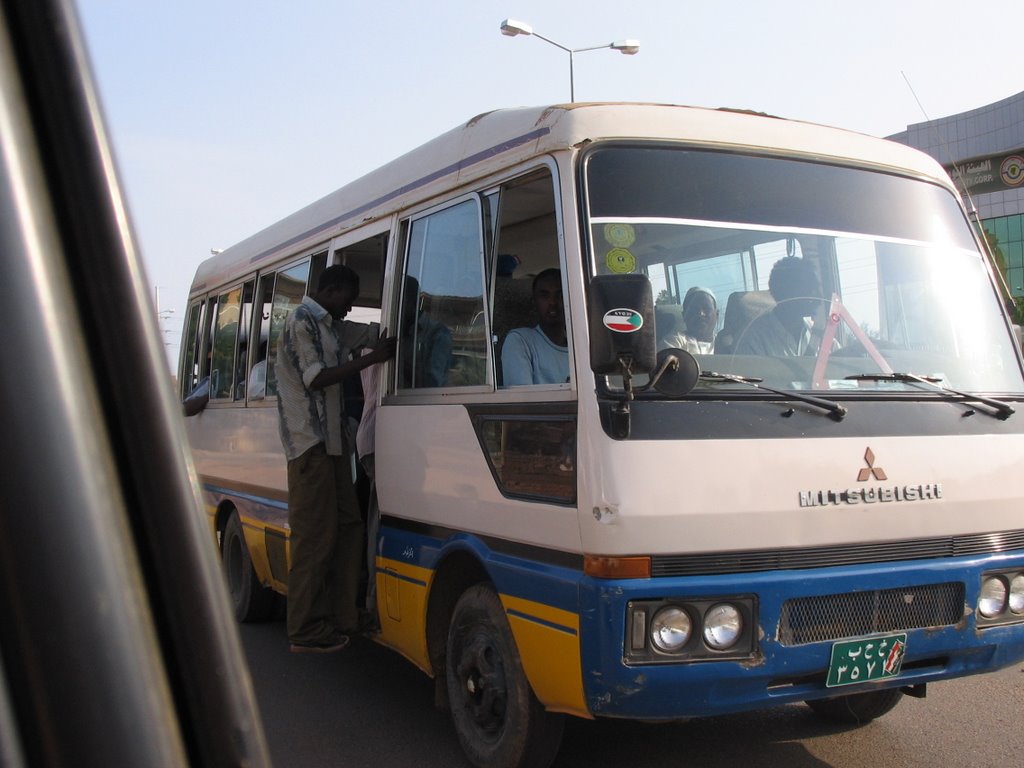
Bus. Costs about 13 cents per person. There are no bus stops—you just wave down the bus when you want to get on and hiss (“Zzzzz, Zzzzz”) when you want to get off. The guy hanging out the door collects the money and tells the driver when to stop to pick people up. The kids ride one of these home from school every day. Isaac and Nora and I sometimes take them on outings, too. Isaac was sitting with me on the bus, watching the money collector swing on and off the bus through the open door, and he said to me, “In Holland, there was a bus with a door that opened AND closed.”

Amjad or Minibus. See the little blue van next to the big city bus? We take one of these across the Nile every week to hippotherapy. Costs more than the public bus but takes you door to door. Holds five passengers comfortably, but we crammed our family in all summer, and this morning four adults and five children crammed into one on the way home from play group.
 Rickshaw. Three-wheeled tiny vehicles, powered by a lawn mower engine. They even have a pull cord to start! They travel only within neighborhoods, and are not for long haul trips. I often see people riding home from grocery shopping, their bags piled in with them. Ed thinks someone should make a computer game featuring rickshaws.
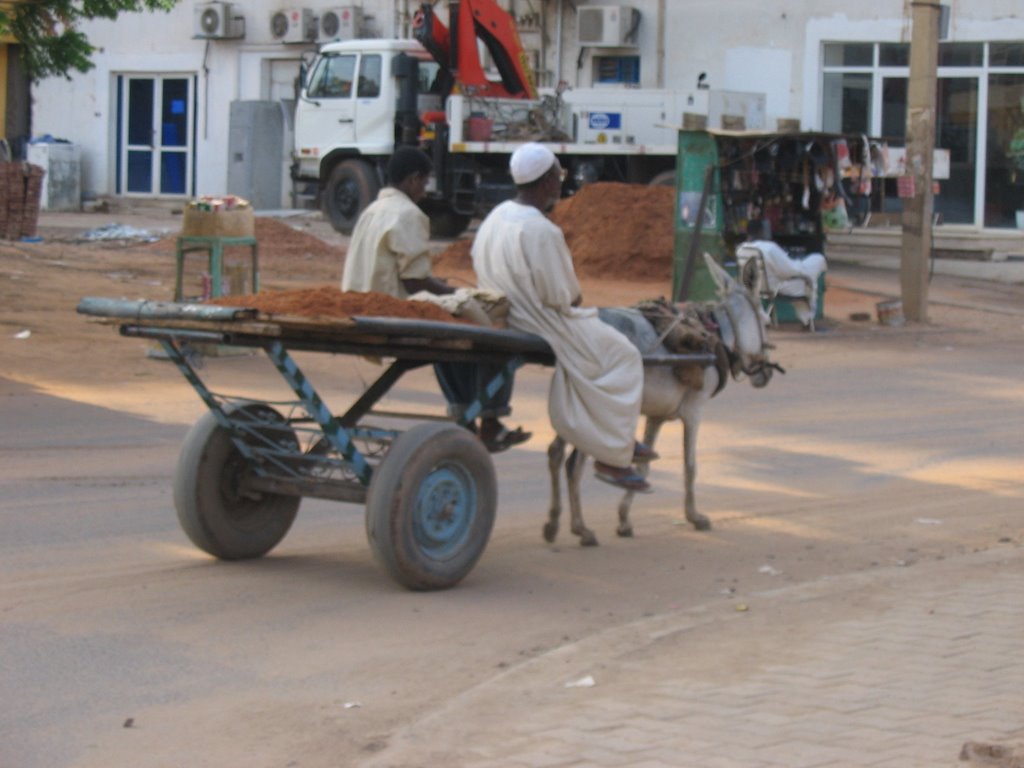
 Donkey cart. Cargo haulers, so we don't actually get to ride on them. They do lend bustling Khartoum a bucolic serenity, though.
Friday, August 18, 2006
Back to School

Much as we came to love and appreciate the kids' school in Holland, I feel relieved to be back in the American system. I feel both that I understand the teachers’ qualifications and credentials and also that my expectations are shared, that I don’t have to explain myself every time we have a question or a problem. The school is very small and very friendly. There are nine kids in Ruth’s grade, ten in Ed’s, and thirteen in Lucy’s. Ed is in an art class with more than 20 kids, which is the biggest class any of them have; most of the classes have a few more or a few fewer than ten kids. Ruth’s AP Chemistry/Physics class has only 3 kids in it. We’ve had some nice conversations with teachers; they appear to be very concerned about helping kids move forward from where they are, and many of the classes are individualized to a greater degree than we’ve seen at other schools (of course the classes are smaller than at other schools, too!).
On the second day of school, David and I met with Ed and the high school science/math teacher to talk about Ed’s electives. On the way out of the meeting, we ran into the principal. He was holding a platter of cut-up mangoes. He took us and Isaac and Nora along with him to feed the school’s tortoises. Last year the fifth grade built a tortoise habitat to provide boundaries for the tortoises, who had taken to chasing kids during recess. There are three small tortoises—each maybe a foot across—and one named Goliath who is about twice as big. Feeding the tortoises was the highlight of Isaac’s day.
Monday, August 14, 2006
Chocolate and other essentials
Dutch chocolate spoiled us. Since the melting point of chocolate is 99 degrees and the average daily temperature is 104 degrees, most chocolate sold here has melted, resolidified, and melted again several times. You can get some refrigerated. Cadbury is especially vigilant about keeping theirs refrigerated all the time—the Cadbury trucks you see around town are always refrigerator trucks—but Cadbury chocolate is pretty nasty if you’re used to Belgian or Dutch chocolate. We’re all going through withdrawals but doing what we can to cope.
Chocolate chip cookies are our main strategy. We’ve been eating store-bought chocolate chip cookies. We can buy Maryland (!) brand cookies which, to my delight, are not made with hydrogenated oil, so we’ve been regularly popping those.
Still, there’s nothing like homemade chocolate chip cookies. For family home evening, Ruth decided to make us a batch of mint chocolate chocolate chip cookies from Mollie Katzen’s Still Life with Menu. She and I went through the ingredient list and made our shopping list. Of course, you can’t buy chocolate chips here, but she found a couple bars of Swiss chocolate that she chopped up to replace them. And you can’t buy vanilla extract, but we did find vanilla sugar. Flour was easy.
And the last thing on our list was butter. That’s where we ran into problems. We have bought butter twice—there’s one kind and it’s in the freezer section—but when I searched, it wasn’t there. The clerk told me they’re all out. So Ruth made a trip to the other grocery store in our neighborhood. They didn’t have any either! We thought about buying a tub of “I Can’t Believe It’s Not Butter” we found up on a high shelf in the corner of the refrigerated section of the store, but it was ten dollars, and we decided we didn’t want it that much. So Ruth scrounged all of the leftover butter we had at home and added a bit of oil to what was missing. It was a winning formula—the cookies were delicious.
Can you make cookies with ghee?
Chocolate chip cookies are our main strategy. We’ve been eating store-bought chocolate chip cookies. We can buy Maryland (!) brand cookies which, to my delight, are not made with hydrogenated oil, so we’ve been regularly popping those.
Still, there’s nothing like homemade chocolate chip cookies. For family home evening, Ruth decided to make us a batch of mint chocolate chocolate chip cookies from Mollie Katzen’s Still Life with Menu. She and I went through the ingredient list and made our shopping list. Of course, you can’t buy chocolate chips here, but she found a couple bars of Swiss chocolate that she chopped up to replace them. And you can’t buy vanilla extract, but we did find vanilla sugar. Flour was easy.
And the last thing on our list was butter. That’s where we ran into problems. We have bought butter twice—there’s one kind and it’s in the freezer section—but when I searched, it wasn’t there. The clerk told me they’re all out. So Ruth made a trip to the other grocery store in our neighborhood. They didn’t have any either! We thought about buying a tub of “I Can’t Believe It’s Not Butter” we found up on a high shelf in the corner of the refrigerated section of the store, but it was ten dollars, and we decided we didn’t want it that much. So Ruth scrounged all of the leftover butter we had at home and added a bit of oil to what was missing. It was a winning formula—the cookies were delicious.
Can you make cookies with ghee?
Sunday, August 13, 2006
And it raineth.
There was this huge thunderstorm a couple of nights ago, with lightning and everything -- somehow that seemed weird for here. When I woke up the next morning, the house smelled like wet dust. Everything was still kind of dripping outside, but Ed ventured out onto the balcony. From there, he had an excellent view of our unpaved street, which, he was quick to inform us, was completely flooded. Well, maybe not completely. There was a little edge up against the houses that one could tiptoe along. And many did. Actually, the path to the nearest grocery is an exciting route through piles of garbage, scaffolding, assorted rubble, and brick stepping-stones through puddles.
My mom posted about the mint chocolate chocolate chip cookies, but I think you should all know that Mollie Katzen (the author of the recipe) claims they are "creative soul food" and that they helped her through the second half of the cookbook. I highly recommend replacing ordinary chocolate chips with chopped Swiss chocolate.
Also, tales of two teachers. We've been getting Arabic lessons from a woman who works at the Sudanese Cultural Center. She comes to our house to teach a lesson 5 times a week, and she came for 4 weeks. We just finished our course. Towards the end, it got to be pretty fun to banter with her in our broken Arabic. Her name is Awatif, which we found out means "emotions". This amuses me. She also translated the name of Ed's friend Basim for us: it means "smiley". Apparently sheep's head, a local delicacy, is also called Basim. "Sudanese people love to eat its mind," she told us, wrinkling her nose. The second teacher is a teaching assistant from the University of Juba, who's giving me and Ed violin lessons for two weeks. He's been coming at 7 PM and teaching until 9, but in the middle, when my lesson is over, and Ed's is about to start, he has to take a little break to pray. Pretty cool. He just takes off his shoes and sets up shop on the rug, facing Mecca. This reminds me of our first night in Egypt, in a Novotel near the airport, very Western, with TV and matching bedspreads and cheap paintings on the wall, BUT. The desk in every room had a sticker on it indicating which way you should face to pray.
My mom posted about the mint chocolate chocolate chip cookies, but I think you should all know that Mollie Katzen (the author of the recipe) claims they are "creative soul food" and that they helped her through the second half of the cookbook. I highly recommend replacing ordinary chocolate chips with chopped Swiss chocolate.
Also, tales of two teachers. We've been getting Arabic lessons from a woman who works at the Sudanese Cultural Center. She comes to our house to teach a lesson 5 times a week, and she came for 4 weeks. We just finished our course. Towards the end, it got to be pretty fun to banter with her in our broken Arabic. Her name is Awatif, which we found out means "emotions". This amuses me. She also translated the name of Ed's friend Basim for us: it means "smiley". Apparently sheep's head, a local delicacy, is also called Basim. "Sudanese people love to eat its mind," she told us, wrinkling her nose. The second teacher is a teaching assistant from the University of Juba, who's giving me and Ed violin lessons for two weeks. He's been coming at 7 PM and teaching until 9, but in the middle, when my lesson is over, and Ed's is about to start, he has to take a little break to pray. Pretty cool. He just takes off his shoes and sets up shop on the rug, facing Mecca. This reminds me of our first night in Egypt, in a Novotel near the airport, very Western, with TV and matching bedspreads and cheap paintings on the wall, BUT. The desk in every room had a sticker on it indicating which way you should face to pray.
Thursday, August 10, 2006
Emma, Lucy, and Emma Lucy
Four days ago we went to the Khartoum American School to register for a year at KAS. The business manager flicked through our folders, calling our names as she passed each of our files. She had called me Emma, which I expected, so I told her I went by Lucy. She looked at me, surprised. "Why, we have another Lucy! What grade are you going into?" she asked
"Seventh," I answered.
We were informed that I was in the same class as Lucy. When mom suggested I go by Emma, we were informed that the other Lucy had a younger sister named Emma.
It's rather ironic. I've been in classes twice as big, and grades usually more than five times as large as the fifteen student seventh grade at KAS, but never before have I met another Lucy, let alone one in my very class, with a younger sister of my first name! We're going to visit Emma, Lucy, and their older brother who is Ed's age later today. I'm not sure yet whether Lucy is amused or annoyed about the name coincidence, but I sincerely hope it is the former.
Off to buy bananas and oranges, unless Ed is too busy to come along...
The next day...
Actually, Ed was too busy to come, so I couldn't get produce yesterday. Mom got it while I was at Emma and Lucy's house. Lucy was amused about the names, just as I had hoped. Every time Emma called for Lucy, we both looked around and said "Which one?"
I'm looking forward to spending a year with Lucy and the rest of the class she described. It sounds like a fun and interesting class. Now it's five days until school, we've got to start waking up earlier than ever, a little bit closer to five than to ten...
"Seventh," I answered.
We were informed that I was in the same class as Lucy. When mom suggested I go by Emma, we were informed that the other Lucy had a younger sister named Emma.
It's rather ironic. I've been in classes twice as big, and grades usually more than five times as large as the fifteen student seventh grade at KAS, but never before have I met another Lucy, let alone one in my very class, with a younger sister of my first name! We're going to visit Emma, Lucy, and their older brother who is Ed's age later today. I'm not sure yet whether Lucy is amused or annoyed about the name coincidence, but I sincerely hope it is the former.
Off to buy bananas and oranges, unless Ed is too busy to come along...
The next day...
Actually, Ed was too busy to come, so I couldn't get produce yesterday. Mom got it while I was at Emma and Lucy's house. Lucy was amused about the names, just as I had hoped. Every time Emma called for Lucy, we both looked around and said "Which one?"
I'm looking forward to spending a year with Lucy and the rest of the class she described. It sounds like a fun and interesting class. Now it's five days until school, we've got to start waking up earlier than ever, a little bit closer to five than to ten...
Wednesday, August 09, 2006
Hippotherapy Photos
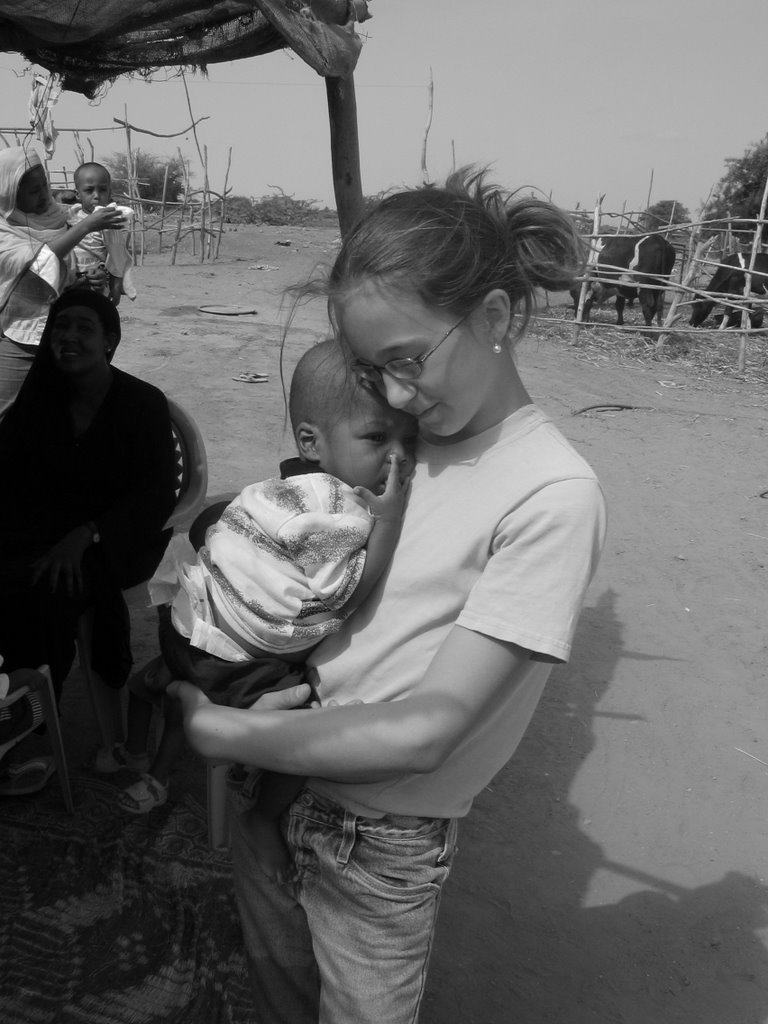
Lucy is very good with the cuddly kids. They settle in on her shoulder and sometimes start to drift off by the time they need to get back in the car to go back to the orphanage.
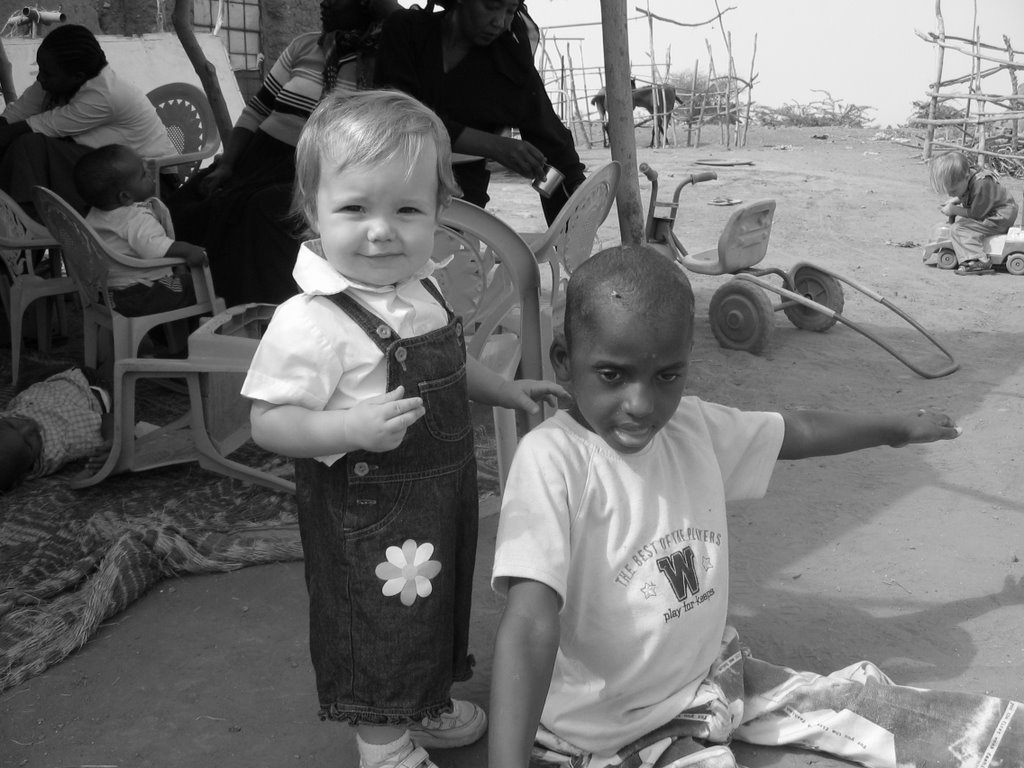
Eleanor patting one of her friends.
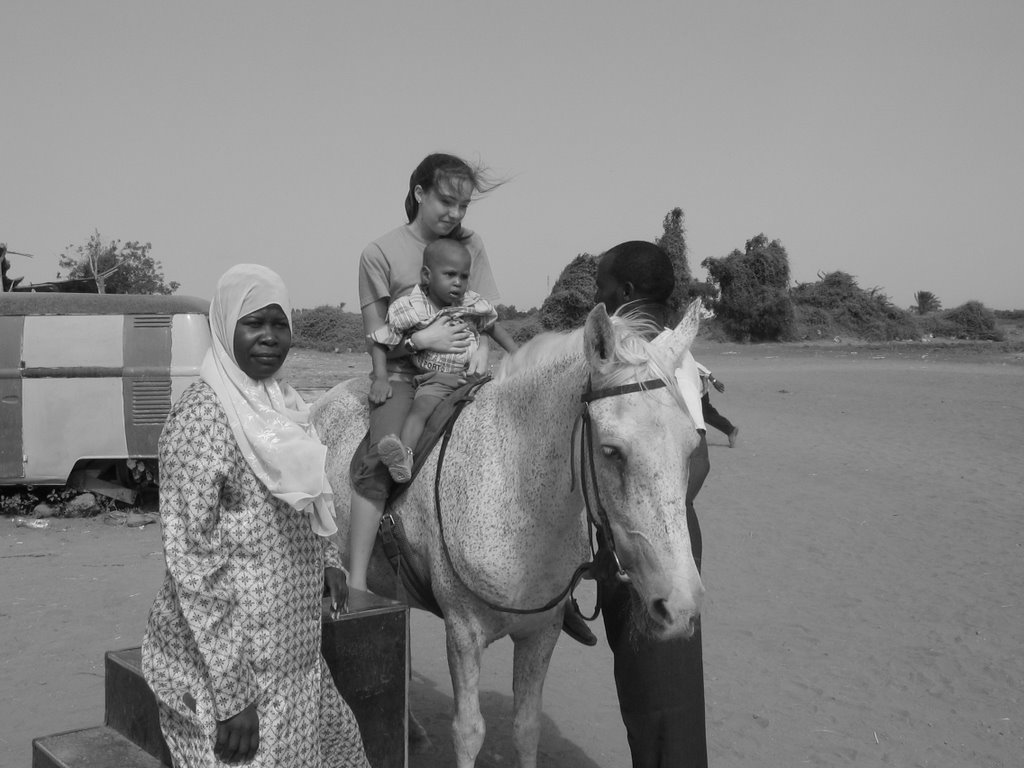
Ruth doing the hippotherapy part of hippotherapy. She especially enjoyed it because the man leading the horse and the nanny from the orphanage spent their time in Arabic and she did a bit of Arabic eavesdropping with her new language skills.
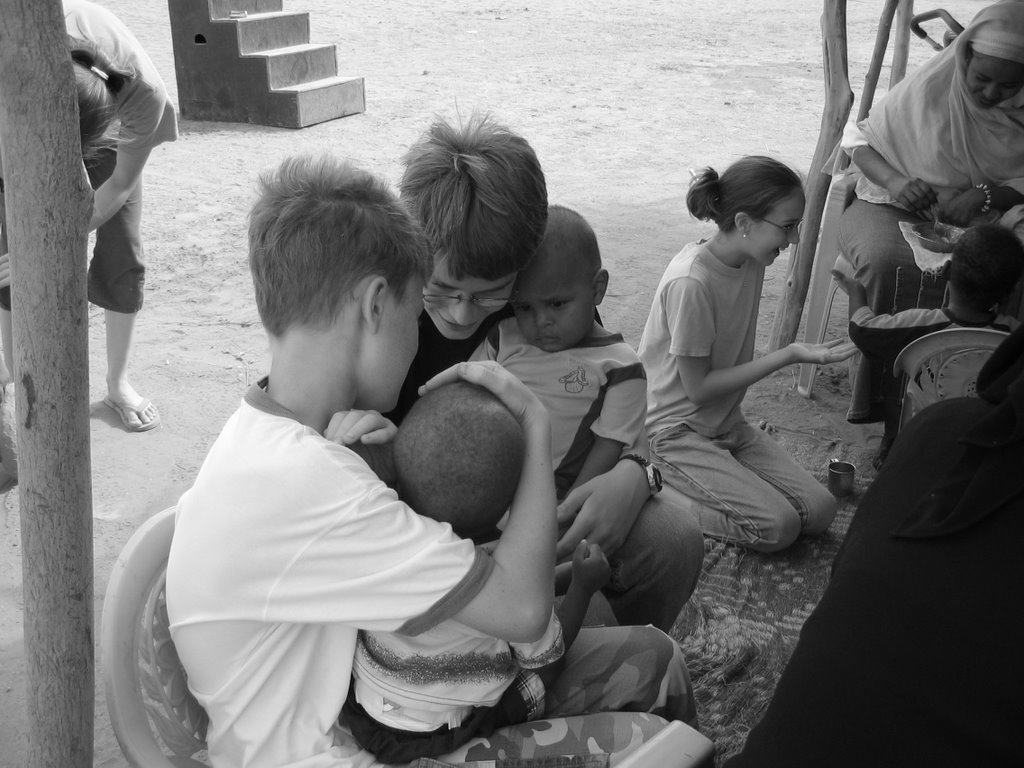
Ed and Arnie with their charges.
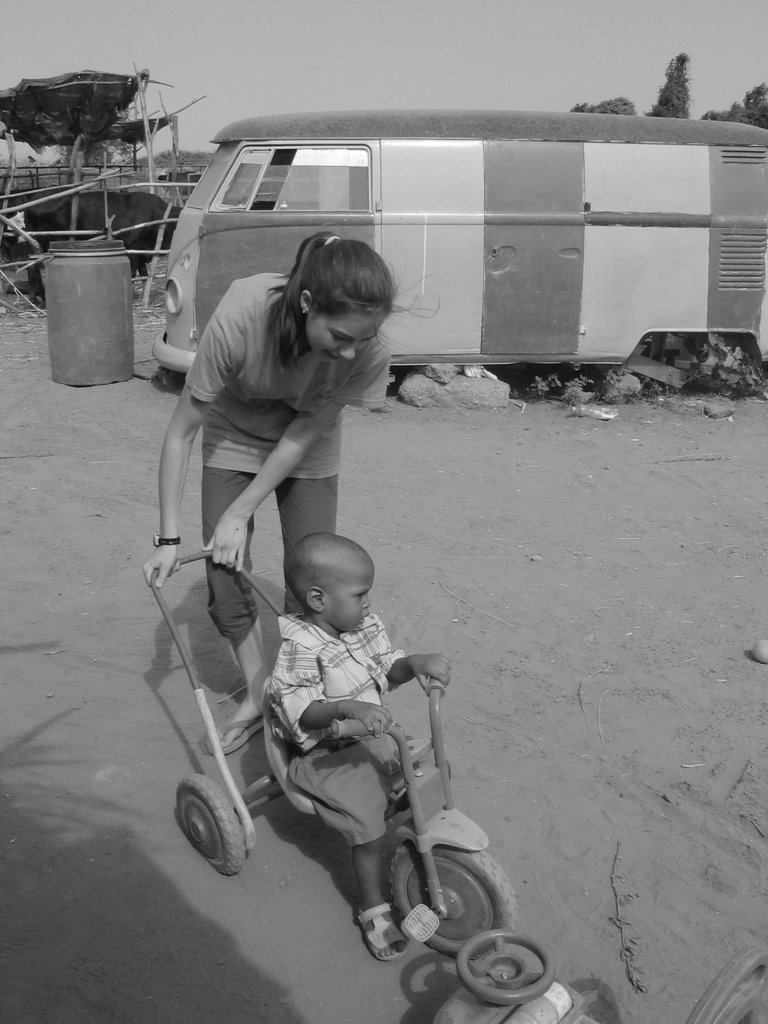 Ruth gives a ride on a tricycle while the horse is occupied.
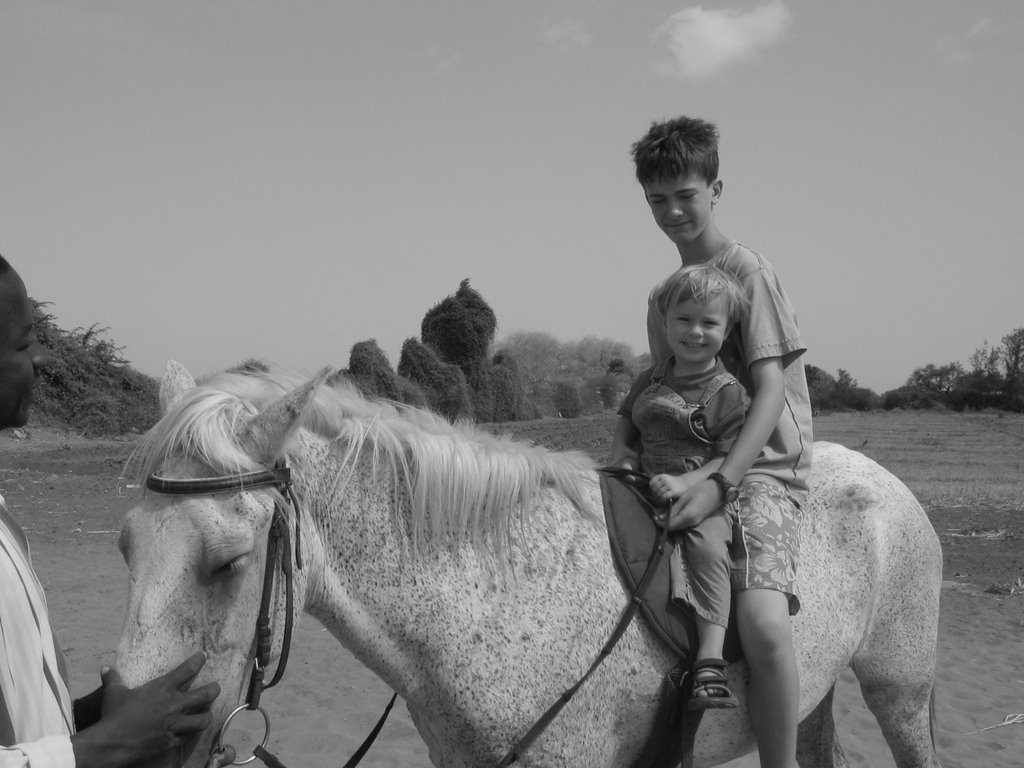 And when all the other kids had ridden, Isaac got a horse ride, too.
What do I expect, living in a desert?
We haven't had water in our taps for 24 hours now. The newly installed pump appears to make no difference.
Occasional water shortages I can deal with--we've made "Refilling water storage jugs" a daily job--as long as I know that's just the way it is in Khartoum. But this morning, after failing to get any water, I walked outside to discover our next-door neighbor washing his sidewalk with a hose and the people two doors down filling a bucket with a hose so they could wash a car! Truly indignant now, I called our realtor. She tried to console me by telling me that she, too, had lost water yesterday from noon until three. I finally made her understand that it wasn't any wimpy little three hour shortage we were dealing with, so she made some phone calls and eventually called back to tell me that there's apparently some repair work going on. I see no repairman in our yard or in the street, so I have my doubts. Aargh!
For a day and a half, nobody in Khartoum had any dial-up Internet service. At least that's back.
Occasional water shortages I can deal with--we've made "Refilling water storage jugs" a daily job--as long as I know that's just the way it is in Khartoum. But this morning, after failing to get any water, I walked outside to discover our next-door neighbor washing his sidewalk with a hose and the people two doors down filling a bucket with a hose so they could wash a car! Truly indignant now, I called our realtor. She tried to console me by telling me that she, too, had lost water yesterday from noon until three. I finally made her understand that it wasn't any wimpy little three hour shortage we were dealing with, so she made some phone calls and eventually called back to tell me that there's apparently some repair work going on. I see no repairman in our yard or in the street, so I have my doubts. Aargh!
For a day and a half, nobody in Khartoum had any dial-up Internet service. At least that's back.
Sunday, August 06, 2006
The Wedding
We went to the neighbors’ uncle’s wedding last night. They had told us to arrive between 8:00 and 8:30. I was panicked at 8:23 when we hadn’t walked out the door yet, but we arrived at the Syrian Club, a couple of blocks from our house, at exactly 8:30 and discovered that there was us, some men setting up speakers, one elderly gentleman, and two tiny little girls there. The space was beautiful. There were white fairy lights (a Briticism for Christmas lights) all over—making an avenue of trees, draped on the walls of the garden, forming a screen near a raised dais with a loveseat for the bride and groom. Forty room-sized Persian rugs formed the central floor, surrounded by row after row of picnic tables with chairs.
We stood in the corner for about fifteen minutes, wondering what to do, until three other people walked in. They walked immediately over to the elderly gentleman and spoke to him, so we followed them. He looked very confused by our presence, but when we finally got him to understand who our neighbors were, his entire face was transformed, wreathed with smiles. He took us over to a table and showed us where to sit, and periodically through the evening came over to check that we were all right.
We had been there about an hour when people finally started to arrive in great numbers. There were a few women wearing the religious hijab—tight around the face—but there were several women there with no head covering at all. Most women, however, wore scarves over their heads, but not as part of the conservative hijab but as part of the long, flowing scarf wrapped around their clothes—yards and yards of filmy, colorful fabric, sometimes with beads or glitter or embroidery, that covered their clothing from their feet on up to be tossed gently over their hair. Every now and then someone would unwrap part of the scarf and toss it back over her head, very elegant, like a dance. It looked like hundreds of delicate, beautiful butterflies had settled around the picnic tables. Made me wistful to have lost that fashion possibility in the West.
We were fed a plate of food—felafel and chicken and burger and rolls and pickles and olives and some baklava kind of thing—as well as a bottle of water and a bottle of Pepsi each. The bridal party, including our neighbors, eventually arrived. I was so impressed by the care our neighbor family took of us. There were 500-600 people there, but each member of the family, all five of them including the 17 year old and 11 year old boys, came over once or twice or three times to shake each of our hands and welcome us and make sure all was well.
At one point Ellie fell down and started crying, so I took her to the side and bounced her on my hip to calm her down. Abdel Aziz, the 17 year old boy, saw me and thought I was trying to dance, so he came over and encouraged us to go to dance in the middle of the floor. Ruth and Lucy bravely helped me take Isaac and Nora out there. It was fun to be in the middle of things, and the dancing was really more just standing in one place (with or without a partner) and moving your arms in time to the music, so I could do it without too much problem. It was interesting to me that the great majority of people dancing were the older guests, not the teenagers and twenty-somethings (though they and the children eventually joined in as well).
It occurred to me while we were there that not only was Isaac the blondest person there, but I think he was also the very only person in the entire place with blue eyes.
We stood in the corner for about fifteen minutes, wondering what to do, until three other people walked in. They walked immediately over to the elderly gentleman and spoke to him, so we followed them. He looked very confused by our presence, but when we finally got him to understand who our neighbors were, his entire face was transformed, wreathed with smiles. He took us over to a table and showed us where to sit, and periodically through the evening came over to check that we were all right.
We had been there about an hour when people finally started to arrive in great numbers. There were a few women wearing the religious hijab—tight around the face—but there were several women there with no head covering at all. Most women, however, wore scarves over their heads, but not as part of the conservative hijab but as part of the long, flowing scarf wrapped around their clothes—yards and yards of filmy, colorful fabric, sometimes with beads or glitter or embroidery, that covered their clothing from their feet on up to be tossed gently over their hair. Every now and then someone would unwrap part of the scarf and toss it back over her head, very elegant, like a dance. It looked like hundreds of delicate, beautiful butterflies had settled around the picnic tables. Made me wistful to have lost that fashion possibility in the West.
We were fed a plate of food—felafel and chicken and burger and rolls and pickles and olives and some baklava kind of thing—as well as a bottle of water and a bottle of Pepsi each. The bridal party, including our neighbors, eventually arrived. I was so impressed by the care our neighbor family took of us. There were 500-600 people there, but each member of the family, all five of them including the 17 year old and 11 year old boys, came over once or twice or three times to shake each of our hands and welcome us and make sure all was well.
At one point Ellie fell down and started crying, so I took her to the side and bounced her on my hip to calm her down. Abdel Aziz, the 17 year old boy, saw me and thought I was trying to dance, so he came over and encouraged us to go to dance in the middle of the floor. Ruth and Lucy bravely helped me take Isaac and Nora out there. It was fun to be in the middle of things, and the dancing was really more just standing in one place (with or without a partner) and moving your arms in time to the music, so I could do it without too much problem. It was interesting to me that the great majority of people dancing were the older guests, not the teenagers and twenty-somethings (though they and the children eventually joined in as well).
It occurred to me while we were there that not only was Isaac the blondest person there, but I think he was also the very only person in the entire place with blue eyes.
Saturday, August 05, 2006
We got our water pump!
Every once in a while (and sometimes for half of every day in the week), water refuses to flow from our faucets. Our realtor told us it was because there is not always enough water pressure to force the precious liquid up the pipes to our second-floor dwelling. SO. She said don't worry, i know a solution, we'll rig you up a pump that you can turn on whenever the water's not working. She ALSO said that this would happen in 2 days. Here it is a couple of weeks later, and Mom (Annette) is off at the airport or who knows where trying to get us resident visas. I hear a knock on the door, and it's an old guy who jabbers at me in Arabic and points at some switches on our wall. I hear "water pump", cotton on, and show him in. He heads to the kitchen, opens our window, reaches up and drags in some dangling electrical wires. I watch him for a while, not entirely sure if he's a workman or a very creative thief, then gradually get drawn away by other things. After half an hour or an hour or so, he comes and gets me, brings me to the kitchen, and shows me this:
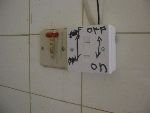
He demonstrates: "Oof . . . on . . . oof. OK?"
Umm . . . OK.
In any case, the pump seems to work.
I wonder how he knew he spelled it wrong the first time . . .
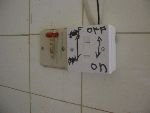
He demonstrates: "Oof . . . on . . . oof. OK?"
Umm . . . OK.
In any case, the pump seems to work.
I wonder how he knew he spelled it wrong the first time . . .
Friday, August 04, 2006
Off to Great Places--He's Off and Away

Sam's gone.
David flew home for about 8 hours. Just long enough to ordain Sam an elder, get a couple hours' sleep, and then take him to the airport at 4 AM.
The ordination was wonderful. It seemed a wonderful way to close this chapter of our family's (and Sam's!) life and to open the next. As I looked at my boy, standing there taller than his father, I kept remembering holding him a couple of hours after he was born when the nurses had finally left and it was just him and me and David. David cried. He was so tiny and new. And now he towers over me and has been taking care of me in strange countries and knows more than I do about just about everything.
David and Eleanor and I took Sam to the airport to go back to the states to college (despite the MIT shirt in the photo, Sam opted for Stanford). They have a great big sign just inside the front doors of the airport that says "Passengers Only." On the easier-to-get-forgiveness-than-permission principle, David just walked through with Sam. He helped him pay his airport tax and present his documents and then came back to me and Ellie, and we went home sure that all was well with Sam. Turned out that right after David left, they decided Sam didn't have the right stamps in his passport. They took him and his passport to a little room and had him fill out forms and pay some money. Thank goodness Sam had the presence of mind and the cash (remembering again why I like the traveling-with-wads-of-cash method of living overseas) to get through it.
And now we've launched him. To infinity and beyond!
Thursday, August 03, 2006
Over the River and Through the . . . Flocks of Goats
Dad's been bringing us books to read from his work's library down in Juba. Last week he also brought a book somebody had lent him: Chew On This, which seems to be a childrens' version of Fast Food Nation. I haven't read FFN, but I just finished Chew On This, and it left me feeling all superior, because Sudan doesn't have any western fast-food chains in it. I was thinking how lucky (?) we are to have lived in 2 different countries that were so recently embroiled in civil war that no McDonald's restaurants have dared start up. Bosnia had its share of imitators, though, including one restaurant with a pirated Burger King sign.
Yesterday after hippotherapy, we went to Tuti Island, which is this little chunk of land in the middle of the Nile. There's a ferry service for people who want to cross to the island, but we (being khawaja, or white foreigners) didn't know the schedule or price. So we just walked up to the dock, which was actually a dirt slope down to the edge of the river, and some enterprising young men with an empty boat offered to take us across for about $2. Great!
Once on the island, we refused several rickshaw rides, thinking that we were being way overcharged. (We never know if people are quoting prices in pounds, which is the old Sudanese currency, or dinar, which is the new money. 10,000 could mean $40, if they're talking dinar, or only $4, if they mean pounds.) Instead, we walked a little ways into the town, which was very small in scale and absolutely silent, except for the occasional rickshaw trundling by. It reminded me some neighborhoods built entirely of mud that we drove through on our day in Omdurman, because the buildings were all 7-10 feet tall, and above that, it was just sky. We found some shade to eat our lunch in, and we were quickly surrounded by schoolboys ages 6-11, who tested out all their English on us. (Good morneeng! Hao arr you?) We tested out a whole bunch of our Arabic on them, too, in very fractured sentences, and gave them chocolate chip cookies. It was pretty fun. Then the women of a nearby house came out and talked to us a little bit, too. Obviously, khawaja are a rarity on Tuti Island. The women told us the name of the tip of the island, where we wanted to go. Then we started walking again, this time with a guard of honor (the schoolboys). When we got tired and expressed an interest in catching a rickshaw, our friends watched until they saw an empty one go by, and then yelled expressively at it until it stopped. In the end, we had to get two (rickshaws are very small -- they typically have only 3 wheels), and were very glad we had, because the ride to the end of the island was long and incredibly serpentine. While in town, we stayed on dirt tracks that were only a few inches wider than the rickshaw itself, and once we met a donkey cart coming the other way and had to back down a side alley. All the town tracks were closely walled by mud houses, so you couldn't see anything around you except for the path ahead of you. Then we would make these right-angled turns, and lose complete sight of the track we'd been on. And when we left town, we passed flocks of goats and crossed little dirt bridges over ditches. It was pretty exciting, and the babies loved it. I thought it should be made into a video game (albeit one for those of a relatively gentle nature), with designing your own funky rickshaw decorations (spikes on the hubcaps and fluffy carpet on the dashboard are common), then finding your way through the maze of the city while avoiding hazards like huge potholes and enemy donkey cart drivers.
One schoolboy accompanied us into our rickshaw and sat up front with the driver. They chatted together and occasionally tried to make Eleanor laugh, but when we got to the edge of town, the driver stopped the rickshaw and told the boy to get off. We didn't understand the Arabic, but it was clear the boy was saying, "Oh, come on, lemme stay just a little while, I wanna watch the foreigners . . ." and the driver was fending him off. In the end the boy hopped off resignedly and we all leaned out to wave and yell, "Ma'a salaama!"
There was another ferry service at the other end of the island, and this time we arrived in time to catch the regular boat, with maybe 15 other commuters on it. We found out that the charge is 9 cents apiece, and Eleanor was free. But hey, I guess those enterprising young men on the other side of the island need our money more than we do.
Yesterday after hippotherapy, we went to Tuti Island, which is this little chunk of land in the middle of the Nile. There's a ferry service for people who want to cross to the island, but we (being khawaja, or white foreigners) didn't know the schedule or price. So we just walked up to the dock, which was actually a dirt slope down to the edge of the river, and some enterprising young men with an empty boat offered to take us across for about $2. Great!
Once on the island, we refused several rickshaw rides, thinking that we were being way overcharged. (We never know if people are quoting prices in pounds, which is the old Sudanese currency, or dinar, which is the new money. 10,000 could mean $40, if they're talking dinar, or only $4, if they mean pounds.) Instead, we walked a little ways into the town, which was very small in scale and absolutely silent, except for the occasional rickshaw trundling by. It reminded me some neighborhoods built entirely of mud that we drove through on our day in Omdurman, because the buildings were all 7-10 feet tall, and above that, it was just sky. We found some shade to eat our lunch in, and we were quickly surrounded by schoolboys ages 6-11, who tested out all their English on us. (Good morneeng! Hao arr you?) We tested out a whole bunch of our Arabic on them, too, in very fractured sentences, and gave them chocolate chip cookies. It was pretty fun. Then the women of a nearby house came out and talked to us a little bit, too. Obviously, khawaja are a rarity on Tuti Island. The women told us the name of the tip of the island, where we wanted to go. Then we started walking again, this time with a guard of honor (the schoolboys). When we got tired and expressed an interest in catching a rickshaw, our friends watched until they saw an empty one go by, and then yelled expressively at it until it stopped. In the end, we had to get two (rickshaws are very small -- they typically have only 3 wheels), and were very glad we had, because the ride to the end of the island was long and incredibly serpentine. While in town, we stayed on dirt tracks that were only a few inches wider than the rickshaw itself, and once we met a donkey cart coming the other way and had to back down a side alley. All the town tracks were closely walled by mud houses, so you couldn't see anything around you except for the path ahead of you. Then we would make these right-angled turns, and lose complete sight of the track we'd been on. And when we left town, we passed flocks of goats and crossed little dirt bridges over ditches. It was pretty exciting, and the babies loved it. I thought it should be made into a video game (albeit one for those of a relatively gentle nature), with designing your own funky rickshaw decorations (spikes on the hubcaps and fluffy carpet on the dashboard are common), then finding your way through the maze of the city while avoiding hazards like huge potholes and enemy donkey cart drivers.
One schoolboy accompanied us into our rickshaw and sat up front with the driver. They chatted together and occasionally tried to make Eleanor laugh, but when we got to the edge of town, the driver stopped the rickshaw and told the boy to get off. We didn't understand the Arabic, but it was clear the boy was saying, "Oh, come on, lemme stay just a little while, I wanna watch the foreigners . . ." and the driver was fending him off. In the end the boy hopped off resignedly and we all leaned out to wave and yell, "Ma'a salaama!"
There was another ferry service at the other end of the island, and this time we arrived in time to catch the regular boat, with maybe 15 other commuters on it. We found out that the charge is 9 cents apiece, and Eleanor was free. But hey, I guess those enterprising young men on the other side of the island need our money more than we do.
Not quite Arsenal
Hippotherapy, Jane Anne’s horse-riding therapy for the local orphanage, takes place at a big paddock in the outskirts of Khartoum. There’s a large, dusty circle where Jane Anne leads the horses around and around with the children on their backs. It’s flanked by tiny mud huts where a couple of families live. There are three fenced-in enclosures, corrals for the animals, one of them formed by the outside walls of the mud huts and the other two constructed from sticks pounded into the ground and held together by wire and string. Jane Anne’s horses are in the mud wall enclosure. One of the other corrals holds horses, tethered by old rags tied to their legs and a post pounded in the ground so they won’t kick over the flimsy fence, and the other corral is full of black and white cows, maybe seven or eight of them.
Tucked in among the mud huts is a reed-covered roof open to the paddock, a welcome spot of shade when we’re outside. Under the shade roof, Jane Anne spreads out a mat (the kind you see men roll out on streets at prayertime) and sets up plastic lawn chairs. When the orphanage truck arrives, we and the nannies schlep the children over to the mat. The first order of business is to feed the children their breakfast—pureed beans (fu’ul, the national food of Sudan)—and then we play with the unoccupied children as, one by one, Jane Anne puts them on the horses.
Haifa comes every week. She’s bigger than most of the other children, but much more physically incapacitated. She can’t walk or even sit up. The nannies just lay her down flat on her back on the mat. She can’t eat solid food, either, and gets only milk for her breakfast. She’s too heavy to carry around for long, but Jane Anne keeps an old stroller at the paddock for her so she can be pushed around and see a bit more than the reeds of the shade roof. Haifa has an enchanting smile. She can’t do much to attract attention—no reaching or grabbing or talking to you—but if you happen to catch her eye, her face is instantly transformed into a warm, transfixing smile.

Last week at hippotherapy, Jane Anne had pulled out some toys for the waiting children. Isaac found a soccer ball. “Play soccer with me, Mom!” he begged.
“Let’s play with Haifa,” I suggested. So we put Haifa in the stroller and bumped it over the dusty field to a fairly open spot between the horse corral and the cow corral. Isaac kicked the ball (threateningly close to the cows).
“You go get it.”
“Then you come talk to Haifa and tell her what we’re doing so she won’t feel lonely,” I suggested.
He trotted over on his sturdy little two year old legs and put one hand proprietarily on the stroller awning while I chased the ball. I don’t know what he said to Haifa, and she probably didn’t either since the only time she ever hears English is once a week at hippotherapy, but she was smiling up radiantly at Isaac when I got back.
Our game soon evolved into a regular rhythm. While I was standing by Haifa’s stroller, Isaac kicked the ball (once into the cow corral—ai yi yi) and while I chased it down, he ran over to be with Haifa. He started going around to the back of the stroller and pushing aside the cloth to poke his head at her peek-a-boo style. She still gave him exactly the same radiant smile, whether he was startling her or not, and they both seemed to thoroughly enjoy the game.
Tucked in among the mud huts is a reed-covered roof open to the paddock, a welcome spot of shade when we’re outside. Under the shade roof, Jane Anne spreads out a mat (the kind you see men roll out on streets at prayertime) and sets up plastic lawn chairs. When the orphanage truck arrives, we and the nannies schlep the children over to the mat. The first order of business is to feed the children their breakfast—pureed beans (fu’ul, the national food of Sudan)—and then we play with the unoccupied children as, one by one, Jane Anne puts them on the horses.
Haifa comes every week. She’s bigger than most of the other children, but much more physically incapacitated. She can’t walk or even sit up. The nannies just lay her down flat on her back on the mat. She can’t eat solid food, either, and gets only milk for her breakfast. She’s too heavy to carry around for long, but Jane Anne keeps an old stroller at the paddock for her so she can be pushed around and see a bit more than the reeds of the shade roof. Haifa has an enchanting smile. She can’t do much to attract attention—no reaching or grabbing or talking to you—but if you happen to catch her eye, her face is instantly transformed into a warm, transfixing smile.

Last week at hippotherapy, Jane Anne had pulled out some toys for the waiting children. Isaac found a soccer ball. “Play soccer with me, Mom!” he begged.
“Let’s play with Haifa,” I suggested. So we put Haifa in the stroller and bumped it over the dusty field to a fairly open spot between the horse corral and the cow corral. Isaac kicked the ball (threateningly close to the cows).
“You go get it.”
“Then you come talk to Haifa and tell her what we’re doing so she won’t feel lonely,” I suggested.
He trotted over on his sturdy little two year old legs and put one hand proprietarily on the stroller awning while I chased the ball. I don’t know what he said to Haifa, and she probably didn’t either since the only time she ever hears English is once a week at hippotherapy, but she was smiling up radiantly at Isaac when I got back.
Our game soon evolved into a regular rhythm. While I was standing by Haifa’s stroller, Isaac kicked the ball (once into the cow corral—ai yi yi) and while I chased it down, he ran over to be with Haifa. He started going around to the back of the stroller and pushing aside the cloth to poke his head at her peek-a-boo style. She still gave him exactly the same radiant smile, whether he was startling her or not, and they both seemed to thoroughly enjoy the game.
Tuesday, August 01, 2006
Guess Who's Coming to Dinner
Hamid, David’s work driver, showed David what he claims is Khartoum’s best Ethiopian restaurant, Habeesha (it’s next door to Top Man barber). We went there last weekend. It had a marvellously small menu—7 items—so we got one of everything that wasn’t raw (we skipped the salad and the raw lamb). We love Ethiopian food—the tangy injera bread, the great toppings on the injera, the whole eat-with-your-fingers sensory immersion—and the experience at Habeesha did not disappoint! After we had eaten we polled everyone to see what their favorites were and every single item of food got somebody’s vote.
There was another Anglophone family (I think perhaps Ethiopian) sitting at the table next to us. They had a thirteen month old girl named Iris who came over first. She was fascinated by Eleanor, and Eleanor was fascinated by her. They stared at each other a while until Iris’ four year old brother, Cesar, came over and put their hands together and encouraged them to give each other kisses. It was a very sweet sight. Iris ended up going back to hang out with her mom, but Cesar pulled up a stool to our low table and joined in the conversation. When our food came, he dug in and ate with us! Later, he went out and picked a flower and tried to give it to Eleanor. She refused it, so he pointed at Ruth and said to me, “I want her to have it.”
We all agree we will make a trip back to Habeesha. Maybe we’ll get a surprise dinner guest again, too!
There was another Anglophone family (I think perhaps Ethiopian) sitting at the table next to us. They had a thirteen month old girl named Iris who came over first. She was fascinated by Eleanor, and Eleanor was fascinated by her. They stared at each other a while until Iris’ four year old brother, Cesar, came over and put their hands together and encouraged them to give each other kisses. It was a very sweet sight. Iris ended up going back to hang out with her mom, but Cesar pulled up a stool to our low table and joined in the conversation. When our food came, he dug in and ate with us! Later, he went out and picked a flower and tried to give it to Eleanor. She refused it, so he pointed at Ruth and said to me, “I want her to have it.”
We all agree we will make a trip back to Habeesha. Maybe we’ll get a surprise dinner guest again, too!
The Curse of the Cabinet
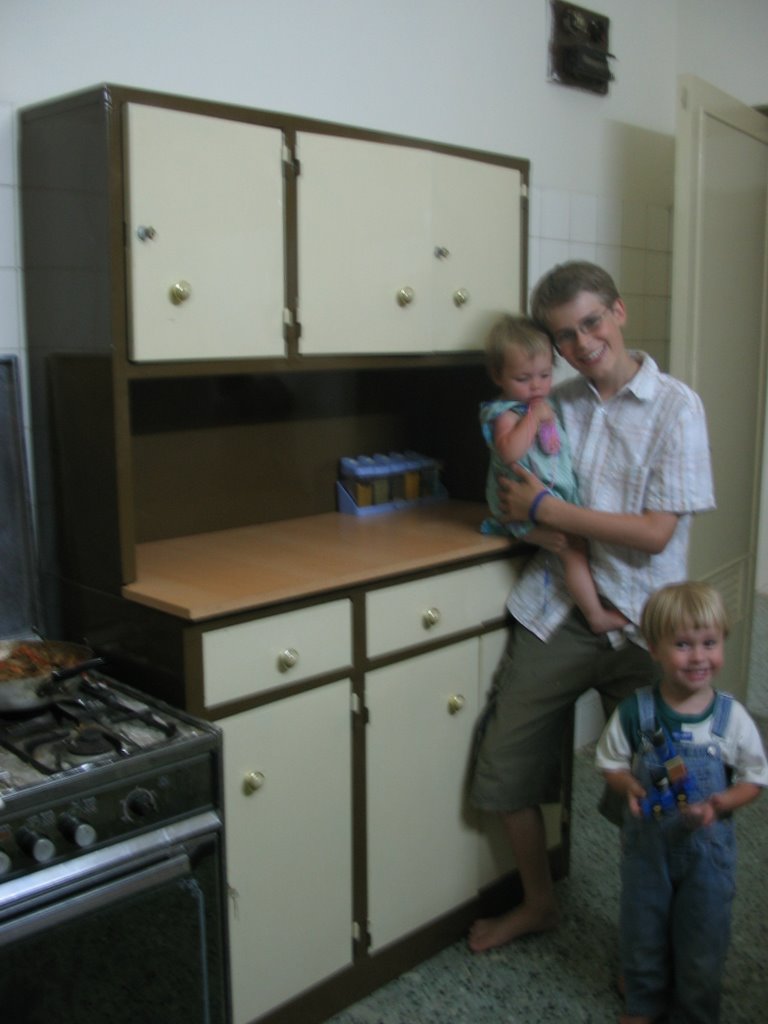
I saw a flyer posted at our neighbourhood grocery store advertising a moving sale. We’re anxious to find bookshelves and some other household goods, so we went to visit. When the door opened, I was startled to see a familiar face! It was the secretary of the American School, one of the few people I have met here. We ended up buying a metal kitchen cabinet from her and her husband.
They helped us wrangle it down the steps from their second story (that’s third story to Americans) apartment, but it was too big to fit into the work vehicle David had borrowed. So, we left it sitting there in front of their apartment overnight. They assured us they would have a pick-up the next day for some of their other things and they could drop it off at our house.
The next afternoon, though, they called and told us their pick-up had broken down and we’d need to find some other means of transportation. David called one of the drivers from work to see if he knew anyone with a pick-up, but when he told us he didn’t, we felt like we had hit a brick wall. We don’t even have a phone book! Our best idea was to go find one of the donkey carts that plies the streets around here and hire that driver to deliver it for us, but we knew our Arabic wasn’t up to explaining that. Eventually, I found some telephone numbers for car hire places in an expat magazine, so I called them. The first one was no longer in business, and the second one, 5M Car Hire, told me they didn’t rent trucks for such a short time. “But as a special one-time favor, to help a foreigner, I will send a driver to pick it up for you.”
True to his word, the manager sent a pick-up truck and driver. The driver helped us lift the cabinet into his truck (did I mention it’s heavy?), but then his truck wouldn’t start. We waited about half an hour, wondering if our new kitchen cabinet carried a curse, but eventually he got it started again and followed us home where he helped us carry it up to our apartment.
When David tried to tip him, he kept refusing the money. Eventually, he convinced him to take it. So, thanks to the generous impulses of a car hire company and its strong, mechanical driver, we now have a well-outfitted kitchen.
More Omdurman photos
The souq was overwhelming--jam-packed with stalls and stuff.
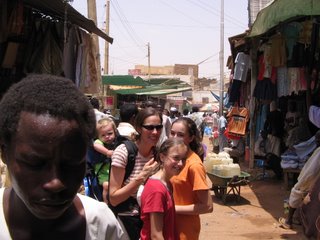

The people to hire for our next move!

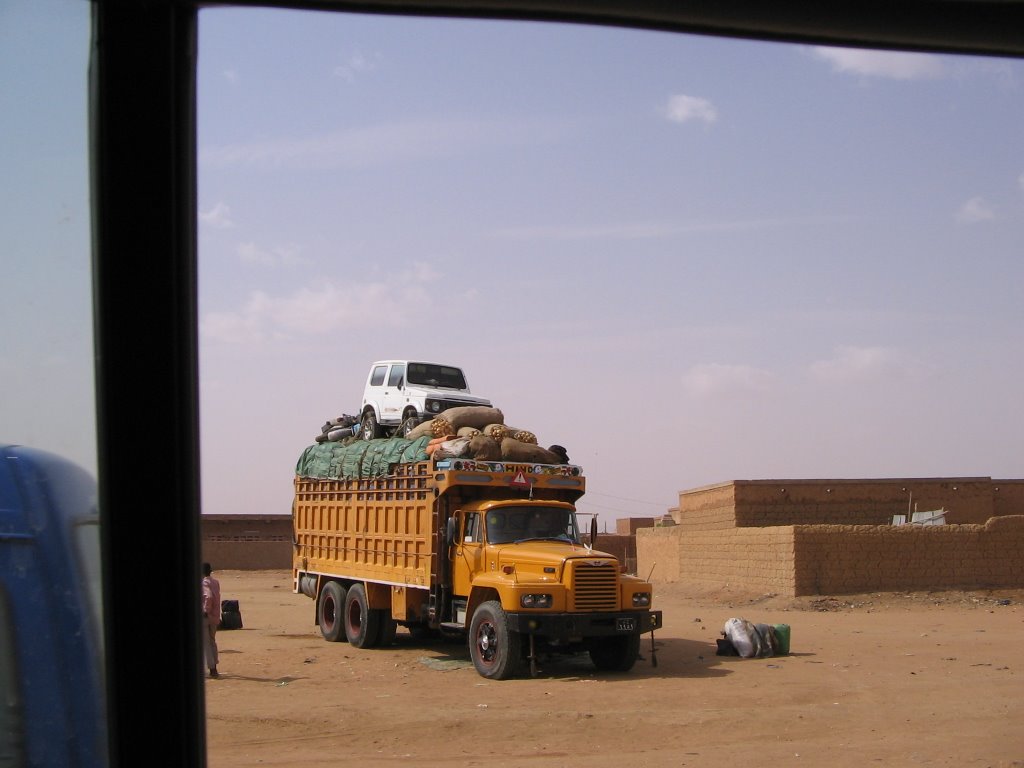
The people to hire for our next move!
Subscribe to:
Posts (Atom)