So here we are, doing a computer program to learn the Arabic alphabet, a set of cd's for the basic greetings, and a class for everything else. Our class is two hours every evening, at the end of which our teacher gives us homework, usually a dialogue to translate, and mostly half of it we don't know. Sometimes all of it, because our teacher gives it to us in past tense, even though we've told her again and again we only know present. What follows is a translation of a dialogue, written as it sounds because we're not that good at the Arabic alphabet yet.
Al yom al awaal fi mudariss Sam yagaanil taalib jedid. Issmu Nusa. Huwa yassalu beitak wein?Sam yajowibu Beiti fi El Amarat janb Shara Muhamed najeeb. Nusa ayagoulayhu Ana saakin hinaak. Mumkin tajee beiti nadruss Arabi? Sam yagoullay Nusa haawil yajee bukra ash-an alaya haamshi maa abi lay agareebra.
Literally translated to English:
The day the first in school Sam meet student new. His name Nusa. He ask him your house where? Sam answer him My house in El Amarat near street Muhamed Najeeb. Nusa say to him I live there. Can you come my house we study Arabic? Sam answer Nusa I try to come tomorrow because today I go with my father to our relatives.
That is perfect Arabic grammar. The main problem I have with Arabic is that there's no 'to be'. I am Lucy becomes I Lucy, and we are given extra verbs such as to be happy and to be sad, because there's no to be that will take initiative and make happy and sad just plain old words. It gets tiring, doing the drills wrong on our computer program, making mistakes on the cd's, and trying to figure out how to say 'hat' for our Arabic lesson. (The word is tagia.)
Tomorrow we're going to al mugran, or the confluence of the Nile.
Ruth tafadil leben min fanta. Ruth prefers milk from fanta. Or so she said last night.
Ana khalas, or I am finished, or literally, I finished. (Not in the French sense!)
Monday, July 31, 2006

Sunday, July 30, 2006
Meet the Wildlife
So all of us kids were sitting around in the living room, as close to the swamp cooler as possible, playing LodeRunner and working on counted cross-stitch. It was dark out, maybe 10 PM or something, and Mom comes in, wide-eyed and trembling. "Did you guys hear me scream?"
No, we hadn't.
She'd been in the bathroom and heard some scrabbling noise, seen something scuttle from one corner to another. She screamed and jumped up on the toilet seat, thinking, "That was way too big to be a mouse!" Startled, the thing swiftly scaled the wall and settled in what it thought was a safe place halfway up the door.
You guessed it: we've got geckos. This particular one was as long as my forearm, and kind of a greenish-gray. Geckos have this way of turning up where you least expect them, but aside from those little moments of horror when I suddenly realize that I've got company, I don't mind them. For one thing, they eat mosquitos. And somehow it's less upsetting to have a cold-blooded, scaled animal sharing my room than furry creatures that build nests and steal loose earrings.
Ed has named the big gecko Steve. He says, "Steve is awesome cool! He looks like a crocodile with a shortened mouth." Why he has chosen the name Steve is still unclear, though I suspect that my mom's little brother Stephen was not considered in the naming process.
And since I promised, let's talk about eggs. At Afra Mall, home of the biggest grocery store in town, one can buy huge square trays of eggs . . . underneath a wall mural of a happy duck family. We think that's just a mistake. Besides, we do most of our food shopping at little streetcorner stores in our neighborhood. The eggs there come in six-packs, and each egg has a tiny round sticker on its point with a photograph of a chicken head. When we first saw them, both me and my mom thought there were pins stuck in the eggs, holding on the sticker. Luckily, that's not the case. However, the yolks are definitely white. When we hardboiled some eggs for breakfast once, the yolks were exactly the same color as the whites, though they were a normal flavor and texture. It was really disconcerting, so I had to eat mine with my eyes closed.
No, we hadn't.
She'd been in the bathroom and heard some scrabbling noise, seen something scuttle from one corner to another. She screamed and jumped up on the toilet seat, thinking, "That was way too big to be a mouse!" Startled, the thing swiftly scaled the wall and settled in what it thought was a safe place halfway up the door.
You guessed it: we've got geckos. This particular one was as long as my forearm, and kind of a greenish-gray. Geckos have this way of turning up where you least expect them, but aside from those little moments of horror when I suddenly realize that I've got company, I don't mind them. For one thing, they eat mosquitos. And somehow it's less upsetting to have a cold-blooded, scaled animal sharing my room than furry creatures that build nests and steal loose earrings.
Ed has named the big gecko Steve. He says, "Steve is awesome cool! He looks like a crocodile with a shortened mouth." Why he has chosen the name Steve is still unclear, though I suspect that my mom's little brother Stephen was not considered in the naming process.
And since I promised, let's talk about eggs. At Afra Mall, home of the biggest grocery store in town, one can buy huge square trays of eggs . . . underneath a wall mural of a happy duck family. We think that's just a mistake. Besides, we do most of our food shopping at little streetcorner stores in our neighborhood. The eggs there come in six-packs, and each egg has a tiny round sticker on its point with a photograph of a chicken head. When we first saw them, both me and my mom thought there were pins stuck in the eggs, holding on the sticker. Luckily, that's not the case. However, the yolks are definitely white. When we hardboiled some eggs for breakfast once, the yolks were exactly the same color as the whites, though they were a normal flavor and texture. It was really disconcerting, so I had to eat mine with my eyes closed.
Trip to Omdurman
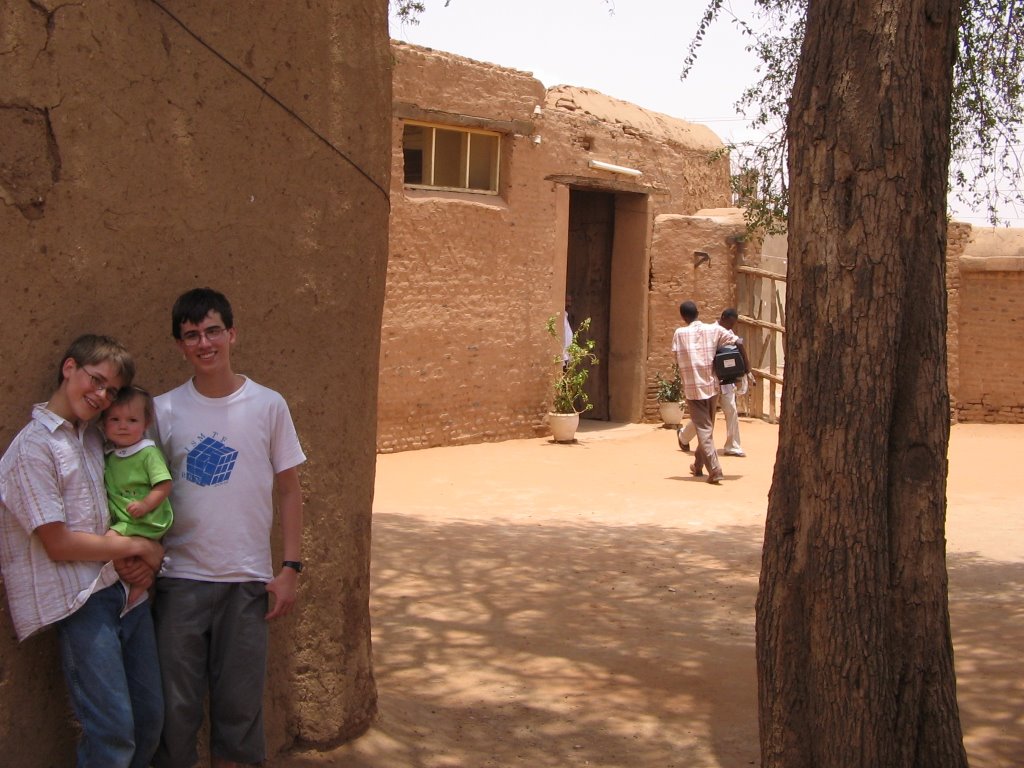
Yesterday we got a photography permit from the Ministry of Tourism (just down the street from the man standing on the sidewalk to skin the sheep carcass). So now we can click away--we've pledged only to take photos of nothing defamatory of Sudan or revelatory of defense secrets.
David bravely drove us across the Blue Nile to Omdurman, an area not much frequented by expats. Amazingly, he managed to find his way without getting lost. We visited a museum, the Khalifa's house (Ed, Eleanor, and Sam against one of the walls of the house). It was an interesting contrast to the museum house we had visited in Cairo--this one reminded us much more of the adobes in the southwestern US.
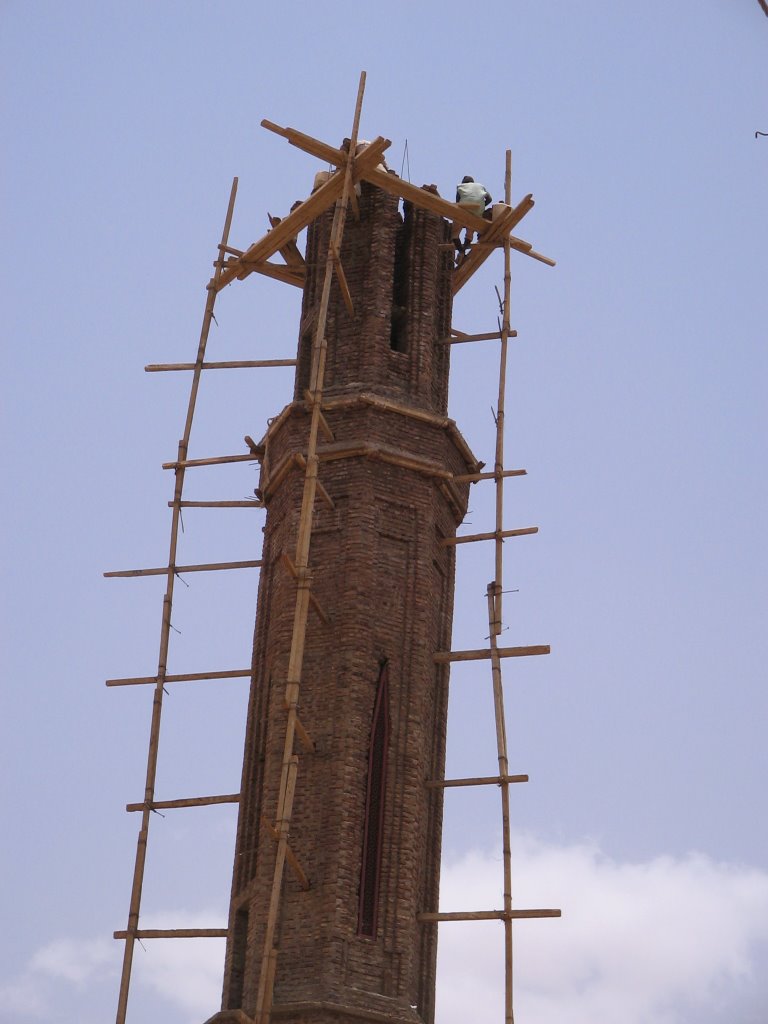
They're repairing the Mahdi's Mosque near the Khalifa's house. Check out the scaffolding around the minaret.
We also visited the souq--the market--in Omdurman. It's the biggest one in the country. I'm sure it's possible to find just about anything there, but we were completely overwhelmed by it and had no idea where to go to find anything. We had a great lunch of kebab there, though.
Our guidebook said there was a camel market west of Omduruman. David followed his instincts and we got in the general vicinity (we kept stopping to ask people the way--as we got closer Ruth drew a picture of a camel for us to show people to be sure they understood us), but we never did see it. We think someone tried to tell us that we were in the right place but that the camel market wasn't operating that day. It was a fascinating drive, though--wonderful to see more of Khartoum and to glimpse the mountains outside of the city.
I love Sabco!
One of the challenges of living in a new country is figuring out where to get what you need. Since we got here, I have twice made pancakes and both times was reduced to flipping them with a spoon. It works, but I decided I really wanted a pancake turner, and I wanted a nylon one so it wouldn't damage the finish of a nice pan David got me. We have two kitchen supply stores near us, but they each had only one metal pancake turner. I had also checked 3 other kitchen supply stores in Al Amarat, but none of them had any nylon utensils. So, David drove me to Khartoum 2, the next neighborhood over, to Sabco. It is an amazing kitchen supply/children's bike store (the combination seems standard--three of the five kitchen supply stores I checked in Al Amarat sell children's bikes too) that has lots of things and lots of really good things. It's where we finally found flatware sets that included table knives. And I found a nylon pancake turner! (Plus a bread knife so we don't smash our bread every time we try to slice it.)
Friday, July 28, 2006
Mark El Polo
We've been going to the swimming pool six days a week, often for several hours at a time. As a result, we meet many interesting people there, especially Sudanese children. I have never, in all my time here, seen an adult Sudanese woman swim. Anyway, a few of the Sudanese children always seem interested in the games we play. When we got here first we played Marco Polo all the time. Four children, intrigued, asked to join. We agreed immediately, because the more the merrier is the rule for Marco Polo. The first of the Sudanese to be tagged was the younger boy. He was very excited at being 'Marco', once we explained what he had to do. After counting to ten, he came up and shouted 'Markel!' We answered with the traditional 'Polo', which he joined. He did not seem to understand us, or else he didn't care, when we explained that he did not say Polo, we did. Marco Polo sounded distinctly Spanish. When we left, we heard behind us the telltale calls of 'Mark El Polo!'
Just yesterday we brought four swimming rings to the pool. We took turns hiding them in the pool, taking as long as needed, as the others closed their eyes. After three of four rounds of this, a young Sudanese boy who called himself 'Achmed', said he wanted to play. When we agreed, he promptly shut his eyes to wait. When we were told to open our eyes, Achmed didn't understand. It seemed he did not understand the game, either, as all he did was swim from one side of the pool to the other, waiting, apparently, for the game to end. Not surprisingly, he never found a ring.
Just yesterday we brought four swimming rings to the pool. We took turns hiding them in the pool, taking as long as needed, as the others closed their eyes. After three of four rounds of this, a young Sudanese boy who called himself 'Achmed', said he wanted to play. When we agreed, he promptly shut his eyes to wait. When we were told to open our eyes, Achmed didn't understand. It seemed he did not understand the game, either, as all he did was swim from one side of the pool to the other, waiting, apparently, for the game to end. Not surprisingly, he never found a ring.
Pioneer Day Dinner with the Neighbors
Last night we had the upstairs neighbors over for dinner. I had invited them the week before and mentioned it to their daughter once during the week, but I still wasn’t sure if the invitation had registered. Apparently it hadn’t. When I went upstairs at 7:30 to tell them that we were ready, the mom was wearing a robe! About an hour and a half later (a typical time for Sudanese to eat supper, we understand), she and her three children came down, and we fed them a pioneer dinner: hot dogs (they have them here! Yummy ones in fact), corn on the cob (nasty and starchy; we won’t do that one again), baked beans (but not really baked—the oven made an exploding noise when I tried to light it so we cooked them on the stovetop), salads, potato chips, and watermelon. We tried to explain Pioneer Day to them. I’m not sure how much they understood.
Everything was awkward and uncomfortable until we started trying to speak to them in Arabic. Actually, I started trying to ask a question in Arabic, and my kids rolled their eyes and said, “Mom!” and asked it with the right pronunciation, and the guests laughed and tried to help me fix my pronunciation. They stayed just long enough to eat—about forty-five minutes--and then left.
I have mixed feelings about how it all went. I think I made them feel awkward, which I regret, but as Ruth pointed out, at least they didn’t feel obligated to stay and stay when they needed to go, and as David pointed out, we had some very awkward meals when people in Bosnia invited us over, but they are some of our fondest memories. The kids pointed out that our best moments in the meal were when we tried to use their language. I’ve appreciated all this particular neighbor family has done for us, so I’m happy to have made a gesture of hospitality and friendship. And I’m going to have to keep inviting people over if I’m going to develop a circle of friends here!
Everything was awkward and uncomfortable until we started trying to speak to them in Arabic. Actually, I started trying to ask a question in Arabic, and my kids rolled their eyes and said, “Mom!” and asked it with the right pronunciation, and the guests laughed and tried to help me fix my pronunciation. They stayed just long enough to eat—about forty-five minutes--and then left.
I have mixed feelings about how it all went. I think I made them feel awkward, which I regret, but as Ruth pointed out, at least they didn’t feel obligated to stay and stay when they needed to go, and as David pointed out, we had some very awkward meals when people in Bosnia invited us over, but they are some of our fondest memories. The kids pointed out that our best moments in the meal were when we tried to use their language. I’ve appreciated all this particular neighbor family has done for us, so I’m happy to have made a gesture of hospitality and friendship. And I’m going to have to keep inviting people over if I’m going to develop a circle of friends here!
Ruminations about Hippotherapy, Intelligence, and Luck
My high school counselor, questioning the value of standardized testing, defined his ideal test of intelligence as dropping someone in another country without any prior knowledge of the language, no money, and no acquaintances or other means of support and then coming back in a year to see how they were doing. At the time, the definition made a big impression on me chiefly because it seemed to have no connection to me and the way I had so far demonstrated my intelligence; up until then I had thought we had firmly established that I was the epitome of intelligence.
Since then, as we have uprooted our family to live in country after country, I have thought a lot more about this definition of intelligence. Personally, I like the wads of cash approach to living in a new country—renting nice homes in safe neighbourhoods, hiring language teachers, buying whatever food and utilities the family needs. Surviving in an unfamiliar culture and language without the money you need would be a remarkable feat. It probably would suggest a high degree of intelligence, but I think it would also suggest a high degree of personal charm, good health, and—most of all—luck.
It has also occurred to me that the scenario Mr. Adams described is not actually so far-fetched or unusual as it seems at first blush. Doesn’t it perfectly describe what happens when a child is born?—he or she is thrust into a strange, unfamiliar culture without any language skills, money, or even clothes! The fact that any of us manages to get along at all is a testament to the remarkable adaptability (and intelligence!) of humans but also points out the role that luck plays. Whether a baby is dropped into a loving, stable, financially secure home or into a tumultuous, drug-ridden, poor home has everything to do with measures of that baby’s success one and two years down the road.
I saw the role of luck when I took my babies along to volunteer at hippotherapy. The kids from the orphanage were just the same ages as my babies—one and two years old. In some ways, they were very much like my one year old and two year old. They were about the same size (though much, much skinnier even than my two rather lean children). They showed widely varying personalities—some of them quick to laugh, some of them happier in the background. But I noticed when we got out the toys, that my one year old eagerly grabbed whatever was held out to her, looked at it, mouthed it, banged it experimentally, and then happily and eagerly reached out for something else. The other one year olds wouldn’t reach out to take toys. My two year old kept trying to offer them toys. They looked at him with interest. They looked at the toy sometimes. But not one of them would reach out and take the toy from him.
I find this deeply disturbing, that already, at thirteen months, my Western child knows how to grab what she wants, but that these African orphans somehow sense that they should not presume to take anything for themselves.
Since then, as we have uprooted our family to live in country after country, I have thought a lot more about this definition of intelligence. Personally, I like the wads of cash approach to living in a new country—renting nice homes in safe neighbourhoods, hiring language teachers, buying whatever food and utilities the family needs. Surviving in an unfamiliar culture and language without the money you need would be a remarkable feat. It probably would suggest a high degree of intelligence, but I think it would also suggest a high degree of personal charm, good health, and—most of all—luck.
It has also occurred to me that the scenario Mr. Adams described is not actually so far-fetched or unusual as it seems at first blush. Doesn’t it perfectly describe what happens when a child is born?—he or she is thrust into a strange, unfamiliar culture without any language skills, money, or even clothes! The fact that any of us manages to get along at all is a testament to the remarkable adaptability (and intelligence!) of humans but also points out the role that luck plays. Whether a baby is dropped into a loving, stable, financially secure home or into a tumultuous, drug-ridden, poor home has everything to do with measures of that baby’s success one and two years down the road.
I saw the role of luck when I took my babies along to volunteer at hippotherapy. The kids from the orphanage were just the same ages as my babies—one and two years old. In some ways, they were very much like my one year old and two year old. They were about the same size (though much, much skinnier even than my two rather lean children). They showed widely varying personalities—some of them quick to laugh, some of them happier in the background. But I noticed when we got out the toys, that my one year old eagerly grabbed whatever was held out to her, looked at it, mouthed it, banged it experimentally, and then happily and eagerly reached out for something else. The other one year olds wouldn’t reach out to take toys. My two year old kept trying to offer them toys. They looked at him with interest. They looked at the toy sometimes. But not one of them would reach out and take the toy from him.
I find this deeply disturbing, that already, at thirteen months, my Western child knows how to grab what she wants, but that these African orphans somehow sense that they should not presume to take anything for themselves.
Tuesday, July 25, 2006
Stuff in Sudanese Stores
In the US and Western Europe, we would decide if we were going to a secondhand or all-new store. Here, though, stores have stuff, brand-new shrink-wrapped puzzles next to battered 1970s vintage Life game in a toy store, new foam mattresses next to many-times repaired floor fans in furniture stores.
There's also a different principle at work to decide what is sold in what store. I haven't yet figured out what that principle is. My favorite store is Fantasia on Fifteenth Street. It is the local merchant for Adidas running shoes, and it specializes in bakery cakes as well. Besides shoes or cake, you can buy chocolate bars and cigars.
There's also a different principle at work to decide what is sold in what store. I haven't yet figured out what that principle is. My favorite store is Fantasia on Fifteenth Street. It is the local merchant for Adidas running shoes, and it specializes in bakery cakes as well. Besides shoes or cake, you can buy chocolate bars and cigars.
Ruth makes an appearance!
Khartoum is different from Cairo in almost every way... except for its huge stock of pseudo-brands and signs in Engrish (that is, mangled English). I've seen Abercrombie & Kent, Panashiba, and today, Chicken Hut, not to mention that favorite of tinkerers and hobbyists everywhere: Sado-Mastic (sic) Emulsion Paint.
Sign-reading gets especially fun when English words or phrases are transliterated into the Arabic alphabet (which I am gaining a stumbling literacy in). I still can't sound out the word on 7-UP bottles, but the script is stylized so that the last letter (reading right to left, of course) looks like the numeral 7. The word Pepsi, however, consists of very basic symbols, and I am happy to mutter, "Beebsee," whenever it makes an appearance (there's no P sound in Arabic), and "Shweebs," for Schweppes.
Brand names in English are definitely considered chic. Besides the T-shirts that leave you wondering if their owner understands what they say, all kinds of products are sold with non-Arabic names. That which disturbs me most is Fair & Lovely skin-lightening cream, flogged with great intensity on our UAE cable channel. In the commercial, a miserable young woman with a tan any westerner would die for is unable to land a television announcing job until she realizes that a quick fix with Fair & Lovely cream will make everything all right. Sure enough, in 6 regular applications, it does! What does this mean for the black-African members of Sudanese society? I don't know.
Next time: white egg yolks and geckos!
Sign-reading gets especially fun when English words or phrases are transliterated into the Arabic alphabet (which I am gaining a stumbling literacy in). I still can't sound out the word on 7-UP bottles, but the script is stylized so that the last letter (reading right to left, of course) looks like the numeral 7. The word Pepsi, however, consists of very basic symbols, and I am happy to mutter, "Beebsee," whenever it makes an appearance (there's no P sound in Arabic), and "Shweebs," for Schweppes.
Brand names in English are definitely considered chic. Besides the T-shirts that leave you wondering if their owner understands what they say, all kinds of products are sold with non-Arabic names. That which disturbs me most is Fair & Lovely skin-lightening cream, flogged with great intensity on our UAE cable channel. In the commercial, a miserable young woman with a tan any westerner would die for is unable to land a television announcing job until she realizes that a quick fix with Fair & Lovely cream will make everything all right. Sure enough, in 6 regular applications, it does! What does this mean for the black-African members of Sudanese society? I don't know.
Next time: white egg yolks and geckos!
Tuesday, July 18, 2006
Hippotherapy
A big adventure today. We volunteered at a hippotherapy (hippo—Greek for horse) session. A British woman, Jane Anne, who married a Sudanese man and settled here in Khartoum gives riding lessons to expat and wealthy Sudanese children (“rich kids” as she puts it) but several times a week gives horse riding lessons to disadvantaged and handicapped kids. We had read about her in an expat magazine and then saw a flyer at our neighbourhood grocery store asking for volunteers to help with the charity lessons.
We had arranged with Jane Anne to attend Tuesday morning when she gives rides to a group from an orphanage. She lives pretty far from us, and on the other—unfamiliar!--side of the Nile, so while David was still here, he and I had driven there and taken copious notes so I could direct a taxi driver. That, of course, would require an English speaking taxi driver, but we got a recommendation, and I had called and arranged with this taxi driver to pick us up early (well, 8:15 AM, not that early) this morning, so I thought we were set.
Unfortunately, we waited and waited and waited and he never appeared. I called him a couple of times, and he never answered his mobile phone. I called Jane Anne to warn her we might not make it, and she gave us a great suggestion. “Just go stop one of those little white mini-vans. They’re cheaper than taxis anyway, and then call me and I’ll tell him where to go.” (These are tiny, tiny vans, micro vans maybe. You can sit two across in them. The kind of van I think Mma Ramotswe has in The Ladies Detective Agency series.) So we hiked out to the main road and flagged down the first mini-van we saw. I whipped out my mobile phone, got Jane Anne, and she gave him directions. It turned out he spoke really good English, so I probably could have directed him anyway. (And now I have his phone number so I can use him again.)
He got us there without any problem and despite the delay our missing taxi caused, we arrived at the same time the orphanage van (a Doctors without Borders vehicle) arrived. The orphanage sent along the psychologist who arranged the visit and five women they called nannies, who care for the children, as well as ten children. Our job was to play with the babies while Jane Anne gave them rides on horses. At one point Lucy helped lead a horse and Ed rode on a horse, holding onto one of the babies, but our main job was to play with the babies—to talk to them, to give them toys, to take them on walks around the pasture to look at things and pet the animals.
This orphanage takes care of children until they are 2 ½ years old, at which point they are transferred either to a Boys’ or a Girls’ Home. At the home, there is a 5:1 adult:child ratio. The children are obviously very well-cared for—they were all dressed in clean clothes and had their hair all fixed and neat. Isaac—in his grimy T-shirt and shoes on the wrong feet (because he dressed himself)—and Nora—who woke up this morning with a runny nose—looked neglected next to these kids. And yet there were certain telltale signs that these kids have a very different life from my kids. For one thing, they were all very skinny. I think of Ellie as being tiny and worry that she doesn’t eat enough, but her legs have shape to them. These little guys had such skinny legs I could hardly believe it. Most striking, though, was to see how they acted next to how Ellie—who’s the same age—acted. Most of them would take a toy if you gave it to them, but only one of the ten kids would actually reach out and try to grab it. Ellie, by contrast, was reaching and grabbing any toy that was in reach. She obviously felt entitled to those toys in a way that the other kids simply didn’t.
I was really happy to have Eleanor and Isaac along. Some of the kids were really interested in Eleanor, and she was very interested back in them. The nannies were also interested in Eleanor and played with them. Isaac got to play the big brother role, showing the little kids how to pet the horses’ noses and giving them toys. Well, trying to give them toys. They tended to not take them when he offered them.
The big kids were really great with the babies. Lucy picked up one little boy soon after we got there. At first he whimpered in her arms but she managed to calm him down and then the two of them were simply inseparable. He cuddled into her shoulder for about an hour. She had just finished singing him some lullabies and nearly put him to sleep when it was time to load the kids back into the van.
Sam took several of the kids on walks around the pasture. One little boy was older than the rest. He is five years old—sadly too old for this home--and suffers from cerebral palsy and is only at the home because he was just (in the past month) abandoned by his mother. He had a love-hate relationship with the horses. He kept wanting Sam to take him close to the horses, but then he would arch his back in fright as they turned their heads toward him. Sam was great, getting him just close enough but then backing away if he started to get anxious. He eventually warmed up to the horses, and Jane Anne ended up giving him two rides on the horses because he loved them so much.
Ed took a little boy to see the horses, but it turned out the little boy didn’t really like horses. Ed pointed out a car on the distant road, though, and got his first smile. After that, all he had to do was to make a car sound and the little guy would grin. Ed was very good at making funny noises that amused the kids. I loved hearing little laughs.
Ruth was great with all the kids. One little boy discovered the great game of knocking over a lawn chair next to Ruth. He would giggle and she would set it back up. I think she must have set that chair up twenty times and he laughed every single time. She spent a lot of time with a very cute little blind guy. She said hello to him in Arabic and he said Hello back to her in English! There was also a sturdy little curly-haired guy who was hilarious—very friendly and funny and eager to play.
I did pretty well carrying Eleanor in one arm and another baby in the other arm. They tended to be more interested in each other than in the farm animals, but that’s not a bad thing! I discovered that some of the quieter, less-engaged kids would light up if I did finger plays and rhymes with them—“This little pig went to market” and “Round and round the garden like a teddy bear” were the two big hits. I guess that combination of gentle touches and the music of rhyming words is unbeatable.
Besides us, there were two other families there volunteering, both from the British embassy. Their kids match up really well in age to our kids’ (and the ambassador’s kids just got here after his assignment in Sarajevo!), but unfortunately they are all boarding school students in Britain and just here to see their parents over the summer holidays. I am thrilled to have found a place that is so welcoming to children volunteers—even baby volunteers!—especially after our disastrous attempts in Romania to find anywhere that would let our kids volunteer. So it was a great day. We’ve already arranged with our mini-van driver to take us back there again next week.
We had arranged with Jane Anne to attend Tuesday morning when she gives rides to a group from an orphanage. She lives pretty far from us, and on the other—unfamiliar!--side of the Nile, so while David was still here, he and I had driven there and taken copious notes so I could direct a taxi driver. That, of course, would require an English speaking taxi driver, but we got a recommendation, and I had called and arranged with this taxi driver to pick us up early (well, 8:15 AM, not that early) this morning, so I thought we were set.
Unfortunately, we waited and waited and waited and he never appeared. I called him a couple of times, and he never answered his mobile phone. I called Jane Anne to warn her we might not make it, and she gave us a great suggestion. “Just go stop one of those little white mini-vans. They’re cheaper than taxis anyway, and then call me and I’ll tell him where to go.” (These are tiny, tiny vans, micro vans maybe. You can sit two across in them. The kind of van I think Mma Ramotswe has in The Ladies Detective Agency series.) So we hiked out to the main road and flagged down the first mini-van we saw. I whipped out my mobile phone, got Jane Anne, and she gave him directions. It turned out he spoke really good English, so I probably could have directed him anyway. (And now I have his phone number so I can use him again.)
He got us there without any problem and despite the delay our missing taxi caused, we arrived at the same time the orphanage van (a Doctors without Borders vehicle) arrived. The orphanage sent along the psychologist who arranged the visit and five women they called nannies, who care for the children, as well as ten children. Our job was to play with the babies while Jane Anne gave them rides on horses. At one point Lucy helped lead a horse and Ed rode on a horse, holding onto one of the babies, but our main job was to play with the babies—to talk to them, to give them toys, to take them on walks around the pasture to look at things and pet the animals.
This orphanage takes care of children until they are 2 ½ years old, at which point they are transferred either to a Boys’ or a Girls’ Home. At the home, there is a 5:1 adult:child ratio. The children are obviously very well-cared for—they were all dressed in clean clothes and had their hair all fixed and neat. Isaac—in his grimy T-shirt and shoes on the wrong feet (because he dressed himself)—and Nora—who woke up this morning with a runny nose—looked neglected next to these kids. And yet there were certain telltale signs that these kids have a very different life from my kids. For one thing, they were all very skinny. I think of Ellie as being tiny and worry that she doesn’t eat enough, but her legs have shape to them. These little guys had such skinny legs I could hardly believe it. Most striking, though, was to see how they acted next to how Ellie—who’s the same age—acted. Most of them would take a toy if you gave it to them, but only one of the ten kids would actually reach out and try to grab it. Ellie, by contrast, was reaching and grabbing any toy that was in reach. She obviously felt entitled to those toys in a way that the other kids simply didn’t.
I was really happy to have Eleanor and Isaac along. Some of the kids were really interested in Eleanor, and she was very interested back in them. The nannies were also interested in Eleanor and played with them. Isaac got to play the big brother role, showing the little kids how to pet the horses’ noses and giving them toys. Well, trying to give them toys. They tended to not take them when he offered them.
The big kids were really great with the babies. Lucy picked up one little boy soon after we got there. At first he whimpered in her arms but she managed to calm him down and then the two of them were simply inseparable. He cuddled into her shoulder for about an hour. She had just finished singing him some lullabies and nearly put him to sleep when it was time to load the kids back into the van.
Sam took several of the kids on walks around the pasture. One little boy was older than the rest. He is five years old—sadly too old for this home--and suffers from cerebral palsy and is only at the home because he was just (in the past month) abandoned by his mother. He had a love-hate relationship with the horses. He kept wanting Sam to take him close to the horses, but then he would arch his back in fright as they turned their heads toward him. Sam was great, getting him just close enough but then backing away if he started to get anxious. He eventually warmed up to the horses, and Jane Anne ended up giving him two rides on the horses because he loved them so much.
Ed took a little boy to see the horses, but it turned out the little boy didn’t really like horses. Ed pointed out a car on the distant road, though, and got his first smile. After that, all he had to do was to make a car sound and the little guy would grin. Ed was very good at making funny noises that amused the kids. I loved hearing little laughs.
Ruth was great with all the kids. One little boy discovered the great game of knocking over a lawn chair next to Ruth. He would giggle and she would set it back up. I think she must have set that chair up twenty times and he laughed every single time. She spent a lot of time with a very cute little blind guy. She said hello to him in Arabic and he said Hello back to her in English! There was also a sturdy little curly-haired guy who was hilarious—very friendly and funny and eager to play.
I did pretty well carrying Eleanor in one arm and another baby in the other arm. They tended to be more interested in each other than in the farm animals, but that’s not a bad thing! I discovered that some of the quieter, less-engaged kids would light up if I did finger plays and rhymes with them—“This little pig went to market” and “Round and round the garden like a teddy bear” were the two big hits. I guess that combination of gentle touches and the music of rhyming words is unbeatable.
Besides us, there were two other families there volunteering, both from the British embassy. Their kids match up really well in age to our kids’ (and the ambassador’s kids just got here after his assignment in Sarajevo!), but unfortunately they are all boarding school students in Britain and just here to see their parents over the summer holidays. I am thrilled to have found a place that is so welcoming to children volunteers—even baby volunteers!—especially after our disastrous attempts in Romania to find anywhere that would let our kids volunteer. So it was a great day. We’ve already arranged with our mini-van driver to take us back there again next week.
Sunday, July 02, 2006
The Lady is a Tramp
Some time between 1 AM and 2 AM, our air conditioner quit working. It was miserable. I even got up and went to the front desk for help, but the guy there knew even less about the air conditioner than I did. In the morning I insisted they fix it before tonight—about 9 PM they finally got it fixed! We’re basking in the coolness (can you bask in anything except heat?).
Our plan was to go to the Postal Museum, one of the top five picks in the Cairo Family Guide book we bought. At the corner, though, Ed’s nose started bleeding, a result, I’m convinced, of his being in a too-hot room for so many hours. Ruth and Sam took Isaac to the museum, and the rest of us took Ed back to the hotel to recover. About half an hour later we tried again. We got to the second corner before the nosebleed started again, so we decided to skip the whole outing.
Ruth and Sam and Isaac enjoyed the museum. It had exhibits about the history of postal services. There were displays of mail carrier uniforms and of taxidermied carrier pigeons. Their favourite thing, however, happened as they were leaving. A very nattily dressed post office employee (the museum is above a post office) stopped to chat with them. After a few minutes, he asked, “Would you like to see the room with our valuable stamps?” They had racks and racks of wonderful, valuable, and old stamps, sorted by country. Ruth and Sam said it was very fun to look through them.
On the way to the museum, they ran into some employees from “our” kushari restaurant out on the sidewalk. “Isaac!” they called. A few minutes later, Ruth noticed that Isaac kept looking over his shoulder. She asked what he was doing. He was looking for Sharif, his teenage street vendor friend who makes such a fuss over him! Luckily, on the way home, Sharif was there, so Isaac got to see him. Ironically, in the evening, we ran into Sharif and his friend on a completely different street; they were on their way home from the cinema. When Isaac saw Sharif, he dropped our hands, grabbed Sharif’s and started off with him!
When Ruth, Sam, and Isaac got back from the museum, we decided that we needed a nearby, highly air-conditioned place for lunch if we had any hopes of getting Ed back into the land of the living. So we went to our nearby Kentucky Fried Chicken. We’re getting kind of sick of Kentucky Fried chicken (and in Cairo! who would have thought), but sometimes circumstances force your hand. And they had a highlights reel going from last night’s very exciting World Cup games, so I got to see the best parts of the games even without making the effort to watch them.
While the kids napped (in our uncomfortably warm room), I ventured onto the streets to reserve plane tickets. We are very used to doing our airline booking online in both Europe and the US, but in Africa it doesn’t work that way. In fact, you can’t really even buy plane tickets at the airport. You have to go to airline offices in the city to book your flights. And some airlines won’t even let you pay with credit cards. It’s a strangely different task than it is elsewhere! I have tentative reservations for us on two airlines, so I can go back and buy one set of tickets when we actually have the visas.
On my way back, I stopped at some clothing stores to look at women’s clothing, and I even tried on a couple of skirts. To my surprise, they were quite a lot too big for me, and they were the smallest ones the store had.
Everyone in the US and Europe who has advised us on clothes for sub-Saharan Africa has told us to be sure to stick with natural fibers like cotton and linen. And I agree that my 100 percent cotton things are by far the most comfortable. Yet, the clothes Egyptian women wear (and the clothes in the Egyptian stores I’ve looked at) are largely synthetic. I’m also surprised by how many layers women wear. The stores have lots of short-sleeved or strappy, knee-length sundresses for sale, and we see women on the street wearing them, but always as the top layer over a long (as in the hem turning black from brushing along the sidewalk) skirt or long, bell-bottom pants and at least one blouse with long sleeves to cover the arms, sometimes a second blouse with a high neck to cover the chest adequately. That and at least two veils pinned around the head. And that’s not even the most extreme women. The seriously covered-up women wear only black and cover all their skin except for that around their eyes—if they’re wearing sandals they wear toe socks and they wear gloves over their hands and they have a third veil that covers the bottom half of their face. Some of them wear glasses, so all you see is veil and glasses. Even Egyptian women who don’t wear the veil almost always wear long sleeved blouses. And it’s hot!
Teenage girls often wear T-shirts with English writing on it over their long-sleeved and high-necked shirts. We never see T-shirts with Arabic writing on it (except for sale at the American University in Cairo bookstore—they obviously know their market as I had just been complaining to the kids that if I were to buy a T-shirt I’d want one with Arabic writing). The English is often just a little bit off, Engrish, as the kids put it. One of the young women who works at the hotel here wore a T-shirt one day that said, “Use it or Lost it.” Tonight I saw one emblazoned with “Yes or Not.” But my all-time favourite was one where the English was just fine. The girl who wore it also wore a long hijab that went halfway down her back, a long-sleeved, high-necked shirt under the T-shirt, and a loose, long skirt that went all the way down to the ground and hid her feet. The T-shirt read, “The lady is a tramp.” I have a feeling that colloquial English was not her long suit.
So, after that little fashion excursion, back to our day. We were very excited to go to the National Circus, which was well reviewed in two of our guidebooks. We found a Nubian restaurant near it, so we took a taxi there and ate dinner (good food that, by and large, could be described as chunks of meat in a gravy-like sauce, just as David had described his typical Juba fare to us). I thought I had read somewhere that we should avoid fresh juices for health reasons (the hygiene of the juicer?), but now we can’t find any such passage, and David has been drinking the fresh juices without any troubles, so the kids and I are enjoying trying them now. We got guava juice and orange juice and lemon juice (sweetened) with our dinner. They were wonderful! Our favourite part of dinner, actually.
We wandered around the neighbourhood for a while because the circus wasn’t scheduled to start till 10:00 (very Egyptian; things start cooling down around then). Had a nice conversation with a friendly grocery store owner who sold us water. We got stared at quite a lot; it was not a touristy area. Finally we made our way over to the circus. At the ticket office, a severe-looking grandma, dressed all in black, spoke to us earnestly, gesturing a lot, and then she walked away. Eventually we figured out that they aren’t doing the circus this week. We felt a bit better when we saw an Egyptian family approach the ticket office and get the same news. They let us go in and look at their ring and their tent at least. But we’re all disappointed that we don’t get to see the circus.
We bought ice cream cones as a consolation on the way home. And we felt happy that both our taxi rides there and back were largely unremarkable. Maybe we’re getting the hang of this taxi thing. And our air conditioner was fixed when we got back to our room.
Our plan was to go to the Postal Museum, one of the top five picks in the Cairo Family Guide book we bought. At the corner, though, Ed’s nose started bleeding, a result, I’m convinced, of his being in a too-hot room for so many hours. Ruth and Sam took Isaac to the museum, and the rest of us took Ed back to the hotel to recover. About half an hour later we tried again. We got to the second corner before the nosebleed started again, so we decided to skip the whole outing.
Ruth and Sam and Isaac enjoyed the museum. It had exhibits about the history of postal services. There were displays of mail carrier uniforms and of taxidermied carrier pigeons. Their favourite thing, however, happened as they were leaving. A very nattily dressed post office employee (the museum is above a post office) stopped to chat with them. After a few minutes, he asked, “Would you like to see the room with our valuable stamps?” They had racks and racks of wonderful, valuable, and old stamps, sorted by country. Ruth and Sam said it was very fun to look through them.
On the way to the museum, they ran into some employees from “our” kushari restaurant out on the sidewalk. “Isaac!” they called. A few minutes later, Ruth noticed that Isaac kept looking over his shoulder. She asked what he was doing. He was looking for Sharif, his teenage street vendor friend who makes such a fuss over him! Luckily, on the way home, Sharif was there, so Isaac got to see him. Ironically, in the evening, we ran into Sharif and his friend on a completely different street; they were on their way home from the cinema. When Isaac saw Sharif, he dropped our hands, grabbed Sharif’s and started off with him!
When Ruth, Sam, and Isaac got back from the museum, we decided that we needed a nearby, highly air-conditioned place for lunch if we had any hopes of getting Ed back into the land of the living. So we went to our nearby Kentucky Fried Chicken. We’re getting kind of sick of Kentucky Fried chicken (and in Cairo! who would have thought), but sometimes circumstances force your hand. And they had a highlights reel going from last night’s very exciting World Cup games, so I got to see the best parts of the games even without making the effort to watch them.
While the kids napped (in our uncomfortably warm room), I ventured onto the streets to reserve plane tickets. We are very used to doing our airline booking online in both Europe and the US, but in Africa it doesn’t work that way. In fact, you can’t really even buy plane tickets at the airport. You have to go to airline offices in the city to book your flights. And some airlines won’t even let you pay with credit cards. It’s a strangely different task than it is elsewhere! I have tentative reservations for us on two airlines, so I can go back and buy one set of tickets when we actually have the visas.
On my way back, I stopped at some clothing stores to look at women’s clothing, and I even tried on a couple of skirts. To my surprise, they were quite a lot too big for me, and they were the smallest ones the store had.
Everyone in the US and Europe who has advised us on clothes for sub-Saharan Africa has told us to be sure to stick with natural fibers like cotton and linen. And I agree that my 100 percent cotton things are by far the most comfortable. Yet, the clothes Egyptian women wear (and the clothes in the Egyptian stores I’ve looked at) are largely synthetic. I’m also surprised by how many layers women wear. The stores have lots of short-sleeved or strappy, knee-length sundresses for sale, and we see women on the street wearing them, but always as the top layer over a long (as in the hem turning black from brushing along the sidewalk) skirt or long, bell-bottom pants and at least one blouse with long sleeves to cover the arms, sometimes a second blouse with a high neck to cover the chest adequately. That and at least two veils pinned around the head. And that’s not even the most extreme women. The seriously covered-up women wear only black and cover all their skin except for that around their eyes—if they’re wearing sandals they wear toe socks and they wear gloves over their hands and they have a third veil that covers the bottom half of their face. Some of them wear glasses, so all you see is veil and glasses. Even Egyptian women who don’t wear the veil almost always wear long sleeved blouses. And it’s hot!
Teenage girls often wear T-shirts with English writing on it over their long-sleeved and high-necked shirts. We never see T-shirts with Arabic writing on it (except for sale at the American University in Cairo bookstore—they obviously know their market as I had just been complaining to the kids that if I were to buy a T-shirt I’d want one with Arabic writing). The English is often just a little bit off, Engrish, as the kids put it. One of the young women who works at the hotel here wore a T-shirt one day that said, “Use it or Lost it.” Tonight I saw one emblazoned with “Yes or Not.” But my all-time favourite was one where the English was just fine. The girl who wore it also wore a long hijab that went halfway down her back, a long-sleeved, high-necked shirt under the T-shirt, and a loose, long skirt that went all the way down to the ground and hid her feet. The T-shirt read, “The lady is a tramp.” I have a feeling that colloquial English was not her long suit.
So, after that little fashion excursion, back to our day. We were very excited to go to the National Circus, which was well reviewed in two of our guidebooks. We found a Nubian restaurant near it, so we took a taxi there and ate dinner (good food that, by and large, could be described as chunks of meat in a gravy-like sauce, just as David had described his typical Juba fare to us). I thought I had read somewhere that we should avoid fresh juices for health reasons (the hygiene of the juicer?), but now we can’t find any such passage, and David has been drinking the fresh juices without any troubles, so the kids and I are enjoying trying them now. We got guava juice and orange juice and lemon juice (sweetened) with our dinner. They were wonderful! Our favourite part of dinner, actually.
We wandered around the neighbourhood for a while because the circus wasn’t scheduled to start till 10:00 (very Egyptian; things start cooling down around then). Had a nice conversation with a friendly grocery store owner who sold us water. We got stared at quite a lot; it was not a touristy area. Finally we made our way over to the circus. At the ticket office, a severe-looking grandma, dressed all in black, spoke to us earnestly, gesturing a lot, and then she walked away. Eventually we figured out that they aren’t doing the circus this week. We felt a bit better when we saw an Egyptian family approach the ticket office and get the same news. They let us go in and look at their ring and their tent at least. But we’re all disappointed that we don’t get to see the circus.
We bought ice cream cones as a consolation on the way home. And we felt happy that both our taxi rides there and back were largely unremarkable. Maybe we’re getting the hang of this taxi thing. And our air conditioner was fixed when we got back to our room.
Saturday, July 01, 2006
Cairo Birthday
I had a nice birthday. The kids made a fuss over me and worried about me. They’re sweethearts.
We took a taxi to Zamelek, a leafy island in the center of the Nile. Our taxi driver was completely taken by Eleanor. I was actually worried about how little he was watching the road, he was so busy leaning over to her and cooing at her. At one point he even used his horn as an instrument to honk out the rhythm of a little song he was singing her.
Even so, we made it safely to the Aquarium, a place a couple of our guidebooks had recommended for children. On the banks of the Nile, in a garden (a true rarity in Cairo, I am coming to appreciate), they have created caves and grottoes out of concrete and put fish tanks inside them. After we paid, a man started leading us around. I thought at first he was an official of the Aquarium but after a while, I realized that none of the Egyptian couples there (as Ruth pointed out, it appeared to be a date place; we saw only one other family with children) had guides. He was a little annoying, insisting we go certain places and not explore other places, tapping all the tanks to try to get the animals to move, and posing us for photos. When we finally managed to lose him, he wanted us to give him a tip of 50 pounds—significantly more than the cost of the entrance. I did give him 20 pounds, and Sam was great, expressing his indignation to the guy and reassuring me that I could just walk away.
It was a funny place. The tanks were very humble. There were maybe ten of them—they had mostly Nile fish like catfish and tilapia. We really liked the turtles, and they had some piranhas too. They also had a tank of goldfish and a tank of guppies. There were some tanks with dusty (!) models of fish and several tanks with formaldehyde-filled tubes storing dead fish—fin to head. The manmade caves and grottoes were fun, cool and mysterious. Isaac liked playing hide and seek in them. And the biggest cave had a colony of bats living in it—very cool to see. In the park area, there was a lovely lily-filled pond and benches under trees.
The aquarium didn’t take as long as we had thought it would, so we walked to the Museum of Modern Art at the end of the island. We should have taken a taxi, but I didn’t have small enough change, and it would have required a walk the other direction to break large bills (taxi drivers do not give change here). It was a little bit too far and by the time we got there, Ed’s nose had started to bleed. Anytime he is in he heat for too long, this seems to happen. I had similar problems at his age and his Bay cousins his age have the same problem, so I think it’s genetic. The guards at the museum were very solicitous of him. The first guard to help us seemed to consider himself Ed’s special protector and kept careful watch over him as he lay stretched out on one of the padded benches in the museum. The other guards would periodically come by and ask Ed’s guard how he was doing.
Ruth loved the museum. I found it vaguely disquieting. I didn’t find the art displayed offensive (though some of it was a bit strange) but I finally realized that the exhibits seemed to me to have nothing to do with the Cairo we have been exploring for the past 2 ½ weeks. I realized that I had seen no art depicting women wearing the hijab, for example. I mentioned this to Sam and after exploring more of the museum, he told me that he disagreed with me, that he thought it did offer interesting perspectives on the Cairo we had seen. I had been chasing babies and not seen all of the museum, so I went and looked at some of the pieces he suggested, and they did seem somehow more true to the Egypt we’ve seen, but I left wondering how the museum really fits into Egyptian culture and society.
By the time we’d gotten Ed better and seen the museum, we were ravenous. We took the train downtown and hunted out a Swiss restaurant we had found in our guidebook. I had just about given up, but the boys tried out their Arabic and got someone to give us directions. We had a wonderful time there. Two o’clock was a good time of day to go—we were about the only customers there, so our whiny and wild babies didn’t disturb anyone else. Because it was my birthday, we splurged and got both fancy fruit drinks and also chocolate fondue for dessert. Our meals were very good, and they came with steamed vegetables which tasted incredibly wonderful. We have been trying to be careful not to eat unpeeled and uncooked vegetables, with the outcome that we were all very hungry for them.
Isaac and Nora collapsed into naps late in the day, and the four big kids went to McDonald’s to watch the World Cup and surf the web (they have free wireless connections here), so I had a quiet evening with sleeping babies and a book. When they came home, the big guys bought me an ice cream cake. Very sweet of them.
We took a taxi to Zamelek, a leafy island in the center of the Nile. Our taxi driver was completely taken by Eleanor. I was actually worried about how little he was watching the road, he was so busy leaning over to her and cooing at her. At one point he even used his horn as an instrument to honk out the rhythm of a little song he was singing her.
Even so, we made it safely to the Aquarium, a place a couple of our guidebooks had recommended for children. On the banks of the Nile, in a garden (a true rarity in Cairo, I am coming to appreciate), they have created caves and grottoes out of concrete and put fish tanks inside them. After we paid, a man started leading us around. I thought at first he was an official of the Aquarium but after a while, I realized that none of the Egyptian couples there (as Ruth pointed out, it appeared to be a date place; we saw only one other family with children) had guides. He was a little annoying, insisting we go certain places and not explore other places, tapping all the tanks to try to get the animals to move, and posing us for photos. When we finally managed to lose him, he wanted us to give him a tip of 50 pounds—significantly more than the cost of the entrance. I did give him 20 pounds, and Sam was great, expressing his indignation to the guy and reassuring me that I could just walk away.
It was a funny place. The tanks were very humble. There were maybe ten of them—they had mostly Nile fish like catfish and tilapia. We really liked the turtles, and they had some piranhas too. They also had a tank of goldfish and a tank of guppies. There were some tanks with dusty (!) models of fish and several tanks with formaldehyde-filled tubes storing dead fish—fin to head. The manmade caves and grottoes were fun, cool and mysterious. Isaac liked playing hide and seek in them. And the biggest cave had a colony of bats living in it—very cool to see. In the park area, there was a lovely lily-filled pond and benches under trees.
The aquarium didn’t take as long as we had thought it would, so we walked to the Museum of Modern Art at the end of the island. We should have taken a taxi, but I didn’t have small enough change, and it would have required a walk the other direction to break large bills (taxi drivers do not give change here). It was a little bit too far and by the time we got there, Ed’s nose had started to bleed. Anytime he is in he heat for too long, this seems to happen. I had similar problems at his age and his Bay cousins his age have the same problem, so I think it’s genetic. The guards at the museum were very solicitous of him. The first guard to help us seemed to consider himself Ed’s special protector and kept careful watch over him as he lay stretched out on one of the padded benches in the museum. The other guards would periodically come by and ask Ed’s guard how he was doing.
Ruth loved the museum. I found it vaguely disquieting. I didn’t find the art displayed offensive (though some of it was a bit strange) but I finally realized that the exhibits seemed to me to have nothing to do with the Cairo we have been exploring for the past 2 ½ weeks. I realized that I had seen no art depicting women wearing the hijab, for example. I mentioned this to Sam and after exploring more of the museum, he told me that he disagreed with me, that he thought it did offer interesting perspectives on the Cairo we had seen. I had been chasing babies and not seen all of the museum, so I went and looked at some of the pieces he suggested, and they did seem somehow more true to the Egypt we’ve seen, but I left wondering how the museum really fits into Egyptian culture and society.
By the time we’d gotten Ed better and seen the museum, we were ravenous. We took the train downtown and hunted out a Swiss restaurant we had found in our guidebook. I had just about given up, but the boys tried out their Arabic and got someone to give us directions. We had a wonderful time there. Two o’clock was a good time of day to go—we were about the only customers there, so our whiny and wild babies didn’t disturb anyone else. Because it was my birthday, we splurged and got both fancy fruit drinks and also chocolate fondue for dessert. Our meals were very good, and they came with steamed vegetables which tasted incredibly wonderful. We have been trying to be careful not to eat unpeeled and uncooked vegetables, with the outcome that we were all very hungry for them.
Isaac and Nora collapsed into naps late in the day, and the four big kids went to McDonald’s to watch the World Cup and surf the web (they have free wireless connections here), so I had a quiet evening with sleeping babies and a book. When they came home, the big guys bought me an ice cream cake. Very sweet of them.
Forehead calluses and crazy traffic
Ruth pointed out to us that you can tell which men are devout. They have calluses on their foreheads.
Prayertime. In Sarajevo, we saw people stream into mosques, especially on Fridays and holy days, to pray. Here, the mosque appears to be optional although the prayers are not. Every afternoon and, especially every Friday morning, certain corners and alleys are suddenly carpeted with green carpet pieces, kind of like indoor-outdoor carpet, and with Oriental style rugs. And men kneel down and pray. It seems to be especially near open markets and wherever the rugs appear, there is a loudspeaker. I think they listen not only to the prayer over the loudspeaker but also to a sermon.
I’m still not used to the craziness of traffic. Lights seem to be largely disregarded. In fact, Ruth has just enough Arabic that she realized a police officer who had pounded on the hood of a car as it started to creep through a red light (in front of him) and then started speaking to the driver, was scolding the driver! “Shame on you. You know better.” Didn’t give him a ticket though. Today we were crossing a street in the crosswalk at a corner. The nearest car was half a block away. Clear back there, it started honking at us and accelerated! When Isaac pleads to be held because he doesn’t want a car to hit him, I have to sympathize.
Last night, in the middle of the night, Ruth started talking in her sleep about the Arabic alphabet.
Prayertime. In Sarajevo, we saw people stream into mosques, especially on Fridays and holy days, to pray. Here, the mosque appears to be optional although the prayers are not. Every afternoon and, especially every Friday morning, certain corners and alleys are suddenly carpeted with green carpet pieces, kind of like indoor-outdoor carpet, and with Oriental style rugs. And men kneel down and pray. It seems to be especially near open markets and wherever the rugs appear, there is a loudspeaker. I think they listen not only to the prayer over the loudspeaker but also to a sermon.
I’m still not used to the craziness of traffic. Lights seem to be largely disregarded. In fact, Ruth has just enough Arabic that she realized a police officer who had pounded on the hood of a car as it started to creep through a red light (in front of him) and then started speaking to the driver, was scolding the driver! “Shame on you. You know better.” Didn’t give him a ticket though. Today we were crossing a street in the crosswalk at a corner. The nearest car was half a block away. Clear back there, it started honking at us and accelerated! When Isaac pleads to be held because he doesn’t want a car to hit him, I have to sympathize.
Last night, in the middle of the night, Ruth started talking in her sleep about the Arabic alphabet.
Subscribe to:
Posts (Atom)